

Moving an office is rarely just a matter of loading furniture onto a van. The planning starts weeks before moving day, the logistics involve more moving parts than a residential move, and the cost of getting it wrong is measured in lost working hours, damaged equipment, and disrupted staff.
For London businesses, those pressures are amplified. Controlled parking zones, building management rules, goods lift bookings, and tight loading windows all add layers of complexity that a removal team needs to anticipate rather than discover on the day.
Best London Removals Ltd has been relocating London offices since 2011, working with businesses across a wide range of sectors, from creative agencies and tech companies to legal practices and investment firms.
Past clients include Ubisoft's London office, Earnix, Barr Gazetas, Ideation.ai, Vega Investment Technologies, Westheath Projects Ltd, G&L Scientific, and a range of other businesses that needed a reliable, professionally managed office move. We have also carried out collections and deliveries for the Attorney General's Office
What makes an office move different from a home move
The fundamentals are the same; items need to be packed, transported, and placed correctly at the destination. But the stakes and the complexity are higher in several ways.
Equipment density. An IT-heavy office has a high concentration of fragile, high-value items in a small space. Monitors, towers, docking stations, server equipment, and cabling all require careful handling and organised labelling so that setup at the new location is straightforward rather than chaotic.
Business continuity. A residential client can live out of boxes for a few days. A business usually can't. The removal needs to be planned around the working week, often completed over a weekend or in phases to keep disruption to a minimum.
Multiple stakeholders. An office move involves facilities managers, IT teams, building management at both addresses, and sometimes HR. A good removals team works around all of them rather than adding to the coordination burden.
London logistics. Loading bays, goods lifts, timed parking suspensions, and concierge sign-in procedures all need to be confirmed in advance. An office in the City operates very differently from one in a West London business park or a converted warehouse in Shoreditch.
How Best London Removals approaches an office relocation
Every office move starts with a survey. For smaller moves, this is often a video call, and for larger relocations, a site visit makes more sense. Either way, the survey covers the collection address, the delivery address, and everything in between, including floor access, lift dimensions, parking constraints, building management requirements, and the volume and nature of items being moved.
From that survey comes a fixed-price, itemised quote. There are no open-ended day rates or vague allowances. The quote reflects what the job actually involves.
On moving day, the team works to a plan rather than improvising. Items are labelled by room or workstation, fragile equipment is wrapped and packed properly, and the loading and unloading sequence is organised to make setup at the new address as efficient as possible.
For IT-heavy offices, coordination with the client's IT team is part of the process. We don't reconnect servers or configure networks, as that is the IT team's job, but we ensure equipment arrives clearly labelled, in the right room, and undamaged, so their work starts from a clean position.
Out-of-hours office moves
Some businesses can't afford any interruption to their working day. For these clients, Best London Removals carries out complete office relocations outside business hours, starting in the evening once staff have left and finishing before the office needs to be operational the following morning.
We have completed moves starting at 7pm and finishing at 4:30am, with everything in place and ready for a 9am opening. Staff arrive at a functioning office. From their perspective, the move happened overnight.
This kind of turnaround requires more than just working through the night. It needs a realistic plan, a team that knows the sequence, and close coordination with building management at both addresses to ensure access is available throughout. Parking suspensions, goods lift bookings, and security sign-in procedures all need to be arranged specifically for out-of-hours access, as the arrangements that work during the day don't always apply at midnight.
For businesses in sectors where downtime incurs direct costs, such as technology companies, financial services, and legal practices, an out-of-hours move is often the most practical option rather than a premium one.
London office sectors we work with
Office moves vary significantly depending on the type of business. Some patterns are worth knowing.
Technology and software companies tend to have a high ratio of equipment to furniture. Monitors, peripherals, development workstations, and sometimes server racks or specialist hardware all need individual attention. Labelling systems and careful packing matter more here than in most other office types.
Creative and design agencies often have large-format monitors, drawing equipment, and physical archive materials alongside standard office furniture. Studio environments sometimes have bespoke shelving or equipment positioning that needs to be replicated at the new address.
Legal and professional services firms typically have dense document archives, confidential materials, and sometimes specialist furniture. Discretion and reliability are as important as physical capability.
Financial and investment firms operate in environments where access, timing, and security are tightly managed. Moves often need to happen outside business hours and within strict building access windows.
Best London Removals has worked across all of these environments. The approach adapts to the sector and the building, not the other way around.

Planning your office move: What to sort before the van arrives
Parking and access in London
Office moves in central London require particular attention to parking. A loading bay that works in theory can become unusable if a suspension wasn't applied for, or if a neighbouring business has a delivery vehicle in the way.
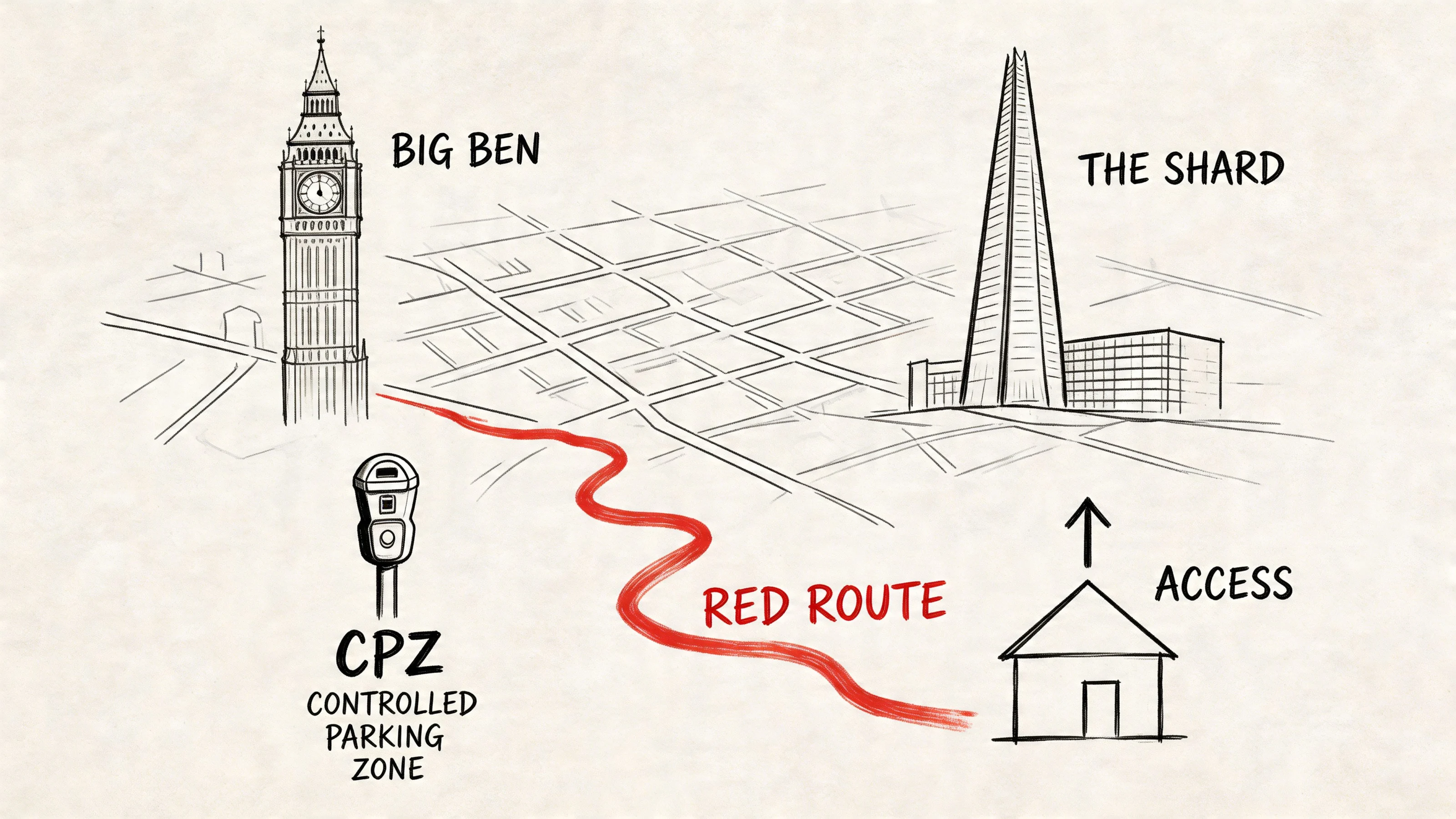
Best London Removals handles parking suspension applications as part of the move planning process. For offices in Westminster, the City, Camden, Islington, or other boroughs with complex CPZ arrangements, this is arranged well in advance. For clients who want to understand the process, our guide to parking suspensions when moving in London covers the borough-by-borough requirements in detail.
Red routes, resident permit zones, and timed loading restrictions all affect how a move is planned. Local knowledge of London's boroughs makes a practical difference, not just in avoiding fines, but in keeping the move on schedule.
Fixed-price quotes and what they cover
Office removal quotes from Best London Removals are fixed and itemised. That means the price accounts for the actual job, including floor access, parking arrangements, equipment volume, and the time required, rather than presenting a best-case rate that stretches the day.
For businesses comparing quotes, the question to ask any removal company is straightforward: what happens if the goods lift runs late, the parking suspension takes longer to action, or the move takes longer than estimated? A fixed-price quote answers that question before the van arrives. An hourly rate doesn't.