
At a glance
Typical cost in London: £120–£600 depending on piano type, stairs and access
Typical duration: 2–3 hours for a straightforward upright move, 4–6 hours when stairs, tight access or a grand piano are involved
Insurance: Goods-in-Transit plus Public Liability should be standard. Ask for cover limits in writing
Team size: Two movers for most uprights, three to four for grands and staircase jobs
Post-move tuning: Usually recommended after 2–6 weeks, typically £80–£150 in London
Your guide to stress-free piano removals in London
A piano is the heaviest, most fragile, most sentimental thing most households will ever move. The difficulty is rarely the weight. It is the combination of a delicate, precisely regulated instrument with a city of narrow staircases, tight lift lobbies, suspended parking bays and period hallways that were not designed with 250 kg of strung cast iron in mind.
This 2026 guide explains what an experienced London piano removals team actually does, what the job should cost, which London-specific hurdles tend to derail the day, and the questions every customer should ask before booking. It is written by the operations team at Best London Removals Ltd, who have completed piano removals across every London borough since 2011 and who hold three independently verified awards for 2026: the NGRS Super Elite Plus Remover Award (eleven consecutive years), the Removals Industry Ombudsman’s Perfect Record Award (zero compensation claims), and the NGRS Professional Standards Commitment Award.
When you are ready to book, our commercial details, fixed-price quote form and coverage areas sit on our piano moving service page
Upright vs grand piano: what piano movers in London need to know
The single biggest variable in a piano move is not the distance. It is the instrument itself. The plan, the crew size, the equipment, the time on site and the price all flex from that one fact.
Why the piano type changes the plan
An upright piano concentrates roughly 200–300 kg of weight onto a small, unstable footprint with hidden internal action that reacts badly to tilting. A grand piano is heavier again (300–500 kg for most domestic grands, more for concert grands), but the weight is distributed across a sprung rim that must be partially dismantled for transport. The lyre, pedals, and three legs are removed, the keyboard cover is locked, and the body is transferred onto a padded skid board in a specific orientation.
That structural difference is why a grand piano move almost always needs more crew, more time and more kit than an upright, even over the same route.
Piano type removal considerations
| Piano type | Typical weight | Crew | Equipment | Time on site |
|---|---|---|---|---|
| Upright (studio) | 150–200 kg | 2 | Piano board, skates, padded dolly, four-wheel trolley | 1.5–3 h |
| Upright (full-size) | 200–300 kg | 2–3 | Piano board, skates, stair climber on stairs | 2–3.5 h |
| Baby grand | 250–360 kg | 3 | Skidboard, dolly, strapping, disassembly of legs/lyre | 3–4.5 h |
| Full grand | 400–500 kg | 3–4 | Skidboard, hoisting straps, disassembly | 4–6 h |
| Concert grand | 500 kg+ | 4 | Hiab / hoist, full disassembly, climate-aware wrapping | 6 h+ |
What works and what doesn’t
The right piano moving method always starts with a survey. Moving an upright on a skate trolley across a single ground floor with a drop-kerb driveway is a genuinely quick job. The same upright, up two flights of a narrow Victorian stair in Highbury with a return at the half-landing, is a different job entirely and needs a crew of three, a piano board, and a planned stair-walk rather than a carry.
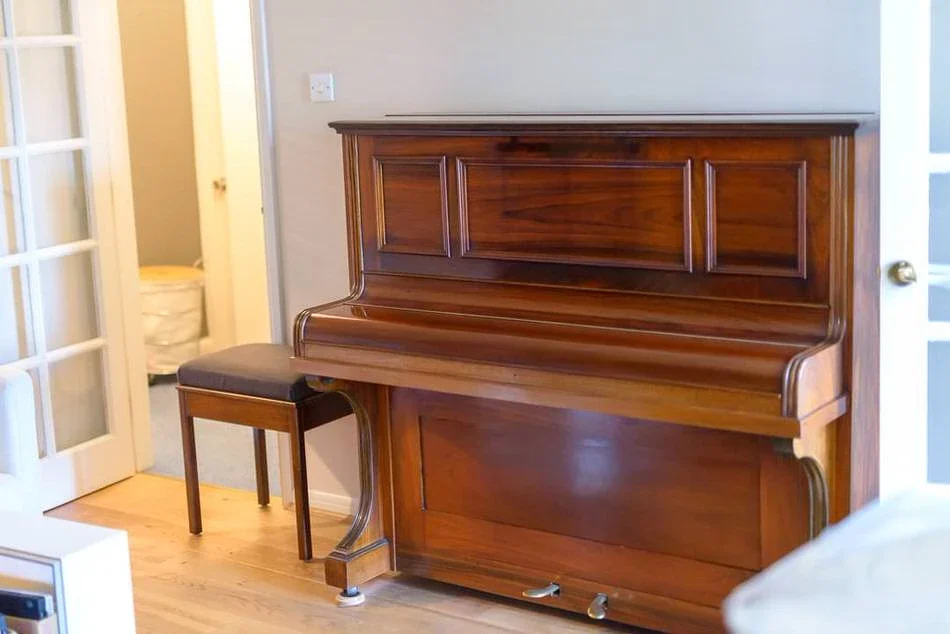
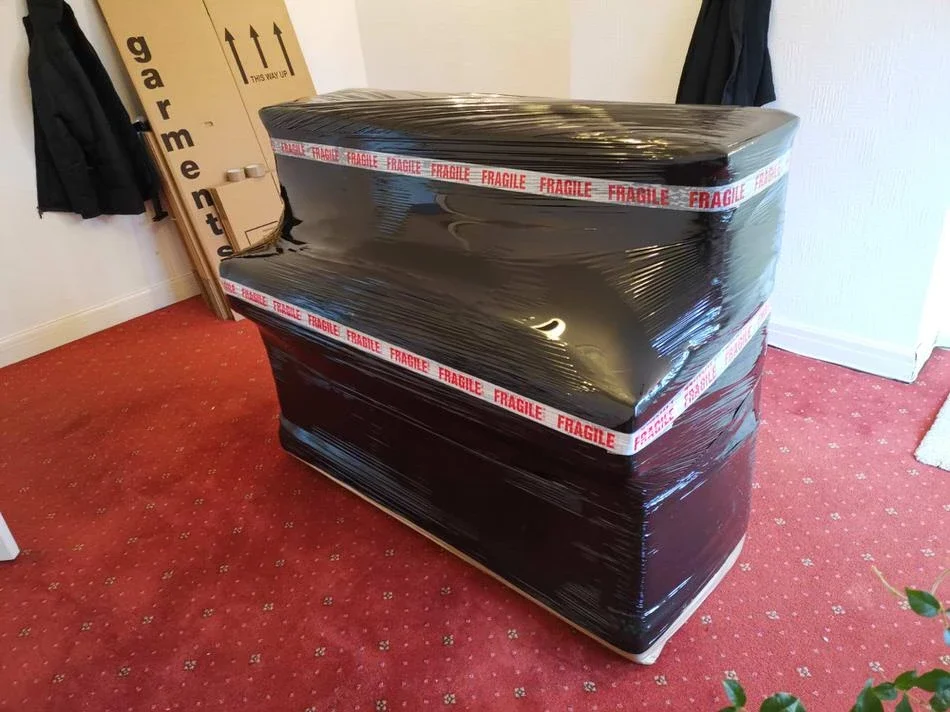
The photographs bellow show the three stages of a typical London upright carry: the piano in its original position before wrapping, the instrument wrapped in quilted moving blankets and secured with Fragile-marked tape, and the piano strapped onto a piano board ready to be walked down a staircase where no lift is available.
The straps are tensioned so the piano sits slightly above the treads, which is what keeps the finish off the walls and the weight distributed safely across the team.


The professional piano removal process explained
Every professional piano move in London runs on the same three-stage framework. If a quoting company skips any of these, that is a warning sign.
Step 1 — Survey and planning before moving day
A proper piano removal starts before the van is booked. Either in person or with detailed photographs and a video walk-through, the team confirms the piano type and dimensions, the access on both sides (doorway widths, staircase returns, lift dimensions, ceiling heights), the parking situation at each address (free bay, paid bay, suspension needed, red route), and the preferred time window. The output of the survey is a fixed-price quote and a written plan: crew size, kit list, route, parking solution, and timing.
Step 2 — How the team handles access and stairs
Moving day starts with protection. Bannisters, doorframes, skirtings and floors are covered. The piano itself is wrapped in quilted moving blankets, then shrink-wrapped, then taped with Fragile-marked tape across every seam. For a grand piano, the legs, lyre and pedal box come off in order and are crated separately. The keyboard lid is locked.
The piano is lifted onto a piano board or skid board, never walked on its own casters for anything beyond a short, level run. On stairs, it is strapped onto the board with the crew distributed so two team members carry the downhill weight and a third controls the top. Carries are slow, deliberate and communicated step-by-step. The team does not improvise, every turn is rehearsed before the piano leaves its starting position.
Step 3 — Loading, transport and final placement
At the vehicle, the piano is loaded onto a lift-equipped luton or box van with tie-down points. It is secured upright (for uprights) or on its skid (for grands), wedged against soft packing, and strapped to the body of the vehicle at three or more points. Driving is slow, the route is planned to avoid harsh cambers where possible, and the team brakes early to keep tuning disruption to a minimum.
At the destination, the process reverses. The piano is positioned in its final spot, unwrapped, wiped down, the legs and lyre are reattached if it is a grand, and the customer checks the finish in person before sign-off. Post-move tuning is almost always recommended, but not on the same day, more on that below.
Decoding the cost of piano removals in London
The single most common question is "how much does it cost to move a piano in London?". The honest answer is that London is not a one-number market. These are the price bands we see across the trade in 2026 for moves inside the M25, based on our own quote history and a review of the public pricing advertised by the top-ranking London piano movers.
| Job | Typical London price |
|---|---|
| Upright piano, ground-floor to ground-floor, inside Zone 1–3 | £120–£220 |
| Upright piano, with one flight of stairs at either end | £180–£320 |
| Upright piano, with two or more flights / tight access | £280–£450 |
| Baby grand piano, ground-floor to ground-floor | £280–£450 |
| Full grand piano, with disassembly | £380–£650 |
| Piano storage, climate-aware facility | £18–£45 per week |
| Out-of-hours or weekend surcharge | +15–30% |
| Parking suspension (TfL / borough) | £40–£200 per bay, passed at cost |
| Post-move tuning (recommended separately) | £80–£150 |
What changes the quote
Five factors move a piano quote up or down more than anything else. Distance inside London is usually the least important of the five.
The first is access on the hardest side; an easily accessible destination is worth nothing if the piano still has to be walked down four floors at the other end.
The second is staircase geometry: a straight run with wide treads is not remotely the same as a Victorian return-stair with a half-landing.
The third is parking: a suspended bay within 15 metres of the front door is a different job to a red-route address where the crew has to carry the piano 80 metres to the van.
The fourth is time window: a Saturday morning job priced against Tuesday afternoon will carry a weekend premium.
The fifth is insurance cover. A mover quoting a headline price without Goods-in-Transit and Public Liability in writing is not cheaper — they are uninsured, and the risk transfer sits with the customer.
Navigating London’s unique logistical hurdles
London adds three problems that most other UK cities do not. An experienced piano movers London team plans around them before the van is booked.
Parking permits and borough rules
Most London boroughs require a pre-booked parking-bay suspension for a vehicle the size of a piano van. Lead times vary: Transport for London red routes need as much as five working days’ notice, while some boroughs will issue a suspension within 48 hours. We book suspensions on the customer’s behalf and pass the cost through at face value. The alternative, turning up on the day and hoping, is the single biggest cause of failed piano jobs in the capital.
School-run streets, market-day streets (Portobello Road, Columbia Road, Broadway Market) and CPZ-only residents’ bays add further layers. The survey covers all three.
Period homes and modern developments
London’s housing stock swings between two extremes that both fight piano moves. Period homes (Georgian, Victorian, Edwardian) typically have narrow staircases with return landings, tight hallway angles and no goods lift. Modern developments often have a goods lift, but only if booked in advance through the managing agent or concierge, with a time slot, a lift-mat requirement and sometimes a lift operator. Either extreme can be handled; neither can be handled on the day.
Purpose-built mansion blocks around Kensington, Marylebone and Bayswater often have generous passenger lifts that look promising but will not take a full upright without the mirror removed. Our team measures twice before quoting.
What to prepare before the team arrives
Clear the route on both sides (rugs rolled back, doors propped, pets in another room). Unlock the piano lid. Photograph the piano from all four sides in case a condition-report discussion arises. Tell the concierge or building manager that a piano is arriving.
Your pre-move checklist and questions for movers
What to ask before booking
There are seven questions a professional London piano removals company should answer without hesitation. Ask them all.
What is the fixed-price quote, in writing, and what would change it.
What is your Goods-in-Transit cover limit, and what is your Public Liability cover limit.
Have you surveyed the access, or is the quote based on customer descriptions only.
How many crew will attend, and have they moved this type of piano before.
Do you handle parking suspensions for me, or is that my responsibility.
Is there an out-of-hours or weekend surcharge, and will the same crew attend the rescheduled date if something changes.
Will the quote hold if you arrive and find the piano is heavier or the access is tighter than expected, or will there be an on-site upcharge.
A reputable firm will give you a straight answer to all questions in advance.
Frequently asked questions
How much does it cost to move a piano in London?
For moves inside the M25, expect £120–£220 for a simple ground-floor upright, £180–£450 for an upright with stairs, and £280–£650 for a grand depending on size and access. The price table above breaks it down.
Does a piano need tuning after a move?
Yes, in almost every case. Vibration during transport and changes in room humidity shift the strings slightly, even when the move is handled perfectly. Let the piano acclimatise for two to six weeks in its new room before booking a tuner, and expect to pay £80–£150 in London. A tuning that drifts immediately after a move is not evidence of mishandling — it is physics.
How long does a piano removal take?
A straightforward upright between two properties with good access typically takes 2–3 hours. Jobs involving stairs, tight internal access or a grand piano that needs disassembly run 4–6 hours. Time is driven by the access at each end and by parking, not by the distance on the road. A two-mile job across Kensington with red-route parking at one end is slower than a ten-mile run with drop-kerb driveways at both ends.
Can you move a piano up stairs?
Yes. Most London piano removals include at least one flight of stairs at one end of the move. The method depends on staircase geometry: a straight run is walked on a strapped piano board, a Victorian return-stair is rehearsed turn by turn before the piano leaves its starting position. Grand pianos over two flights usually need a crew of four and sometimes a temporary hoist.
Do I need a parking permit for a piano removal in London?
In most London boroughs, yes. The vehicle size used for piano removals almost always requires a pre-booked parking-bay suspension, particularly on red routes, school-run streets and residents’ bays. A competent mover books the suspension on the customer’s behalf and passes the cost through at face value.
What insurance should a piano removal include?
Two policies. Goods-in-Transit protects the instrument itself while it is being transported. Public Liability covers accidental damage to the property (walls, floors, banisters) or injury during the move. Both should be declared in writing with cover limits before the job is accepted. If only one is offered, do not book.
How far in advance should I book a piano move in London?
For straightforward moves, one to two weeks is normally enough. For moves needing a parking-bay suspension (most central London jobs), book at least ten working days ahead. For moves into or out of mansion-block goods lifts, book as soon as the moving date is fixed, lift slots are often the binding constraint.
Can I move the piano myself with a van and a couple of friends?
You can, but the sensible answer is no. Upright pianos fall unpredictably once tilted beyond about 20 degrees; amateur lifts are the single most common cause of crushed toes, damaged instruments and torn banisters seen by piano tuners. The saving versus a professional quote almost never outweighs the risk, and any damage is not covered by a standard home contents policy.
Ready to book?
For a fixed-price quote, crew size confirmation, insurance documentation and parking-suspension handling, visit our piano moving service in London or call 0800 080 7476. We cover every London borough, we carry NGRS and Ombudsman cover, and we have been moving pianos in London since 2011.