
Londoners usually start the same way. A late-night search, ten tabs open, every removals website promising care, value, and reliability. One quote looks cheap but says very little. Another looks polished but still leaves questions about parking, stairs, lift bookings, and what happens if the day runs over.
That's why searching for the best removal companies london can be misleading. A smooth move in Ruislip, Kensington, Camden, or Westminster rarely comes down to a slogan or a star rating alone. It comes down to process. The firms that do the job properly tend to ask better questions, inspect access properly, explain charges clearly, and deal with London's awkward logistics before moving day.
Across thousands of London moves, one thing becomes clear. The difference between a calm move and a stressful one is rarely brute force. It's planning, transparency, and local knowledge. The guide below gives a practical way to judge any removals company on those standards.
Finding a London removal company you can trust
Finding a removals company in London isn't the struggle. The difficulty lies in distinguishing a polished website from a reliably efficient operation.
That matters because London exposes weak planning quickly. A company can sound convincing on the phone, then arrive in Notting Hill with the wrong van, no clear plan for the goods lift, and no idea that the street sits inside a controlled zone with limited loading options. By then, the client is committed and the stress has already started.
A trustworthy removals company usually shows its standards early. It asks about the property, access, packing needs, timing, and whether the building has restrictions. It doesn't rush to throw out a vague figure after a two-minute call.
A reliable removals firm should make the move feel clearer before booking day, not foggier.
There are also clues in how the company communicates. Clear written quotes, straightforward answers about insurance, and sensible questions about borough-specific issues often reveal more than marketing language does.
A useful shortlist should filter companies against a few practical points:
That framework works far better than searching for the loudest claim of being the best. In London, competence tends to look quieter. It appears in preparation, paperwork, and how few assumptions the company makes.
The foundation of a good removal company
Why accreditation matters before price
Before looking at price, check whether the company has real third-party oversight. In removals, that means far more than a badge in the footer.
Professional bodies such as the National Guild of Removers & Storers and the Removals Industry Ombudsman matter because they point to standards around conduct, insurance, and accountability. They also give clients somewhere to turn if a dispute ever needs formal handling. That's a major difference between a structured removals business and an unregulated operator taking one job at a time.
There's a practical reason this comes first. A cheap quote from a company with weak standards can become expensive once things go wrong. Late arrivals, damaged items, no clear complaints path, and unclear cover all cost time and peace of mind.
Across the London market, the pattern is consistent: top-performing removals firms tend to score between 4.8 and 5.0 on Trustpilot, and those results align closely with professional accreditation and transparent quoting practices. Reputation and process tend to move together.

What those badges should mean in practice
Accreditation should show up in behaviour, not just branding. A properly run company should be able to explain:
Practical rule: If a company is proud of its membership but vague about what it entails, keep asking questions.
The benchmark is simple: does the company hold a current membership with a recognised body, and can it explain what that membership requires of it? Any well-run firm should be able to answer both questions without hesitation.
Accreditations won't lift a sofa, protect a stairwell, or book a loading bay on their own. But they do tell clients that the company has chosen scrutiny over shortcuts. In this trade, that's a strong place to start.
Decoding the quote: fixed price vs hourly rates
A quote often looks simple until moving day turns awkward. Then the structure of the quote becomes the whole story.
The biggest divide in London removals is between a fixed-price, itemised quote and an hourly rate. Neither model is inherently wrong. The right choice depends on the job, and a good removals company will help the client understand which one fits their situation.
When hourly pricing works well
An hourly rate is a perfectly sensible option for the right kind of job. Man-and-van bookings are the clearest example. If a client has a modest volume of belongings, everything is already packed and boxed, the move involves a single floor or straightforward ground-floor access, and there's nothing that requires dismantling or reassembly, then an hourly booking can be both flexible and good value.
In these cases, a professional company will usually do more than simply quote a rate. They will assess the scope of the job and suggest a realistic time estimate, for example advising that a job of this size would typically take three to four hours, or four to five. That kind of guidance gives the client a working cost to plan around, while keeping the booking straightforward.
Hourly pricing also suits situations where the client prefers not to have a survey, is confident the job is simple, or wants to manage packing independently.
What hourly pricing requires from the client
The hourly model works cleanly when the client's side of the job is well prepared. Several things affect how long the clock runs, and they're worth understanding before booking.
The walking distance from the property to where the van can park matters more than most people expect. A long corridor, a staircase with tight turns, or a lift that requires waiting all add time. If a client hasn't mentioned these details during booking, the team can only estimate, and the estimate may not reflect reality once they arrive.
Packing readiness also affects the final bill. A professional removals team will never refuse to help with items that aren't packed when they arrive, because wrapping, boxing, and preparing belongings is part of the job. But finishing off the packing takes time, and if a client booked on the assumption that everything would be ready, that time will appear on the invoice.
The simplest way to keep an hourly booking on track is to communicate clearly before the day: access conditions, walking distances, what needs wrapping, what's already in boxes, and whether any items need dismantling. The more the team knows in advance, the more accurately they can plan the job.
A red flag that sometimes appears in reviews
A pattern worth knowing about surfaces occasionally in reviews of certain man-and-van operators. The job is booked, the team arrives, the van is half full, and then the operator refuses to take a small number of items that weren't specifically mentioned on the phone. Not a piano or an extra wardrobe. A few boxes that still need packing. A lamp. A second bicycle where only one was mentioned. An extra chest of drawers.
The van has space. The job is straightforward. But instead of loading and moving on, the operator asks for a significant fixed charge on top of the agreed rate, sometimes £150 or more on a job that was quoted at £240 to £260.
This is not how a professional hourly operation works. When a client is paying by the hour, the team's job during that time is to load, carry, pack where needed, and deal with what's in front of them. Walking up two flights of stairs is not an extra. Dismantling a bed is not an extra. Packing a box or two is not an extra. These are part of the work the hourly rate already covers.
A well-run removals company on an hourly booking will handle minor additional items as a matter of course, and if something genuinely changes the scope of the job, will have a straightforward conversation about it, not present the client with a large add-on charge once the van is at the door and the client has no practical alternative.
This distinction matters when choosing a man-and-van operator. Reviews often reveal this behaviour clearly: look for patterns where customers mention surprise charges on the day, refusals to take items, or a sharp change in attitude once the booking was confirmed.
When fixed pricing is the right choice
For larger or more complex moves, a fixed, itemised quote tends to give both parties a cleaner outcome. When a move involves furniture that needs dismantling and reassembly, properties with restricted access, multiple floors, goods lift bookings, or parking suspensions, fixing the price in advance forces the company to plan properly, and removes the risk of the bill rising on the day because something wasn't accounted for.
A good example was a mansion flat move in Kensington where the client had three quotes. Two were hourly and didn't address the building's goods lift booking window and parking arrangements. The fixed quote set those points out clearly, including the suspension cost and the time allowance for the lift slot. On the day, the lift booking overran slightly, but because the quote was fixed, the client paid what had been agreed.
A quick comparison of quote styles
The London logistics test: parking and property access
London removals are won or lost on access. That's the part generic "best of" articles usually miss.
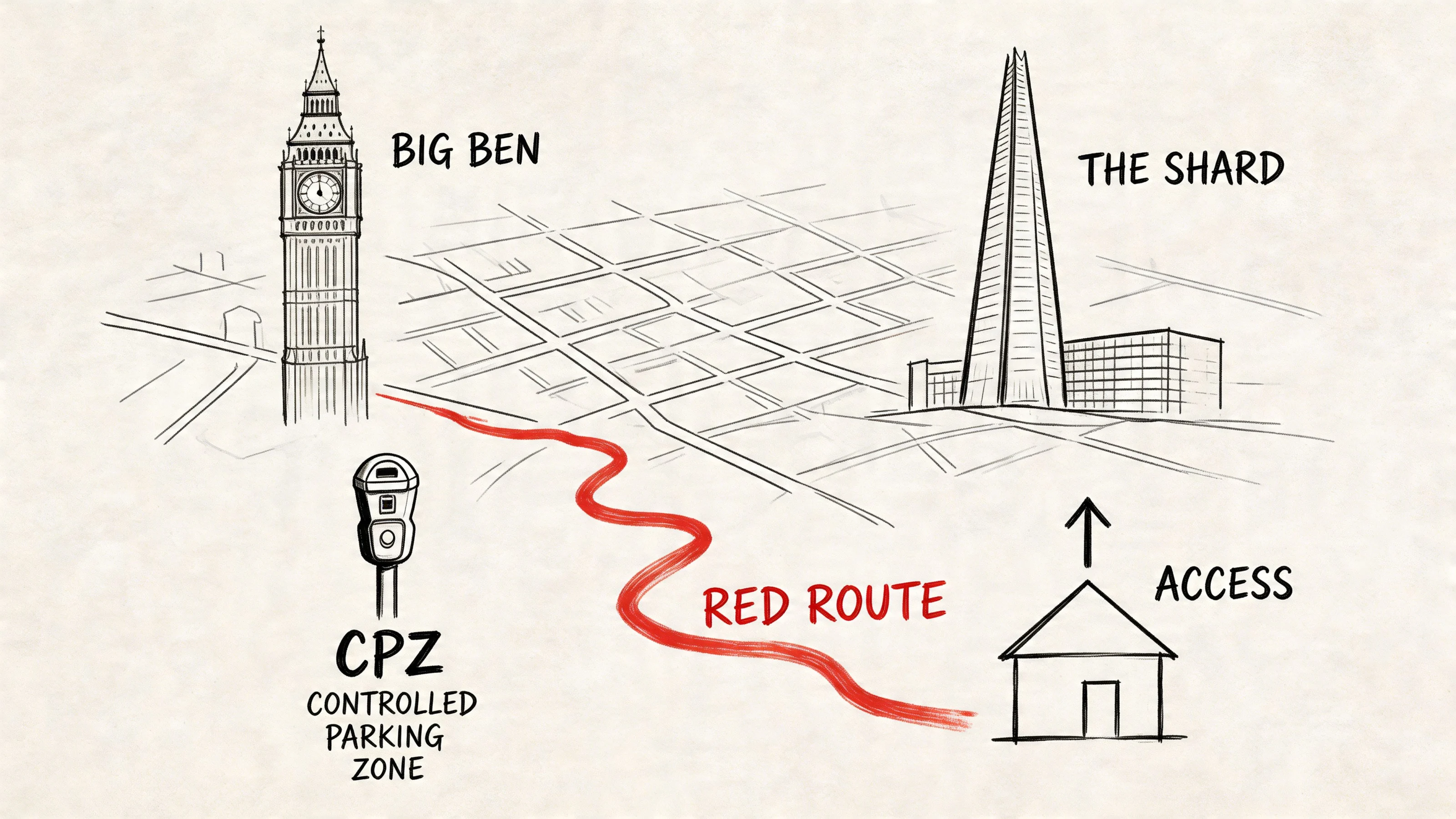
A company can have polite staff and a tidy van, then still fail the most important test if it doesn't understand parking suspensions, controlled zones, red routes, porter rules, concierge booking systems, or how long a carry from the door to the vehicle really takes. In places like Westminster, Camden, Kensington and Chelsea, and parts of the City, those details are often more important than the distance between addresses.
The practical problems that catch clients out
Controlled Parking Zones are estimated to affect around 70% of moves in central London boroughs, a figure that lines up with what experienced removals teams encounter every week. Parking is rarely a side issue in central London. It's a core part of the job plan.
Westminster is a good example. Controlled zones cover much of the borough, red routes remove stopping options in key areas, and loading windows can be narrow. The practical answer is usually straightforward but needs handling early: apply for the suspension well in advance through the council, plan the loading window carefully, and where possible start earlier before traffic builds.
Clients should expect a removals firm to ask about these points well before moving day:
The one question worth asking early
The most useful question many clients never ask is this: Are parking arrangements and road-related charges included in the quote, or treated as extras?
That one question often reveals how transparent the company really is. Clients tend to compare van size and hourly rate first. Meanwhile, parking suspensions, congestion-related costs, and low-emission zone charges sit in the background until the invoice changes.
One useful check: ask the company to confirm in writing how parking, waiting time, and restricted-access costs are handled.
A strong London removals company won't wait to be prompted. It will raise the issue itself during the survey and quote stage, because local knowledge only helps if it's used early.
Why a professional survey is non-negotiable
A proper survey is where the quote, the logistics plan, and the crew requirements all come together. Without it, the rest is guesswork.
In London, guessing is especially risky because properties can look straightforward on paper and still hide awkward access. A second-floor flat in Hammersmith might have no lift. A townhouse in Islington might have difficult stair turns. A mansion block in Kensington might require lift reservations and strict timing.

What a proper survey actually checks
The survey isn't only about counting boxes. It should assess volume, access, fragile or oversized items, furniture that needs dismantling, and whether the property has any restrictions that will affect loading.
That matters all the more in London given the city's denser housing stock. London moves involve an average of just 2.72 rooms per property, the lowest of any major UK city, and smaller properties don't automatically mean simpler removals. Flats often involve tighter access, denser layouts, stricter building rules, and more careful vehicle planning.
A solid survey usually checks:
Why skipping the survey is risky
When a removals company offers a firm price without properly inspecting the job, one of two things is usually happening. Either the company is pricing loosely and hoping for the best, or it intends to recover uncertainty through extras later.
That's why the survey should never feel like an inconvenience. It protects the client as much as the company. A quick video survey often works well, especially when it's followed by a written quotation that records the agreed scope and access notes. A useful guide to getting a proper moving quotation should make clear what information needs to be captured.
A survey is the first serious sign that the company is planning the move, not simply booking a van.
If a company resists surveying the job, treats access questions lightly, or gives different answers each time the client asks what's included, that's a warning sign worth taking seriously.
A guide to your London removals questions
What do reviews and awards really tell you?
Reviews matter, but not in the way many people assume. A consistent five-star pattern is useful when it reflects the unglamorous parts of the job being done well, repeatedly. That means turning up on time, communicating properly, protecting items, handling setbacks calmly, and sticking to the agreed scope.
Awards can also help, but only when they sit alongside clear processes. A badge doesn't mean much if the quote is vague or the survey was skipped. What clients want to see is alignment: good reviews, recognised accreditation, sensible paperwork, and a professional survey should all point in the same direction.
Useful signs in review patterns include:
A company doesn't need perfect wording on every review to be trustworthy. It needs a recognisable pattern of competent service.
What insurance should a removals company have?
This should be asked directly. A professional removals company ought to explain its goods-in-transit and public liability cover in plain English, including any conditions that apply.
The important point isn't only whether insurance exists. It's whether the company can explain what it covers, how claims are handled, and whether there are limits or exclusions the client should know about before booking.
Clients should ask for clear answers to:
A hesitant or evasive answer usually tells its own story.
Should packing and inventory planning be included?
Not every client needs a full packing service, but every client benefits from proper inventory thinking. Packing, labelling, and room-by-room planning reduce confusion on the day and make unloading far more efficient.
A well-run removals company should also be able to confirm whether it offers:
What are the clearest red flags before booking?
Some warning signs are obvious. Others are easy to miss because they appear as a convenience.
Watch for these:
The safest removals booking usually feels slightly more thorough at the start, not faster.
How should a client compare companies fairly?
The simplest way is to compare written details, not just price. Put the quotes side by side and check whether each one addresses the same job in the same way.
Look for differences in scope, access planning, timing assumptions, and whether likely charges have been raised upfront. The best decision usually comes from asking which company seems to understand the move most accurately, not which one typed the lowest number into an email.
For London homeowners, renters, students, landlords, and office managers, that's the true filter. The best removal companies London clients remember positively are usually the ones that remove uncertainty before they remove furniture.