

Almost every move turns up things you’re not taking with you. A wardrobe that won’t fit the new place, a sofa you’re replacing anyway, three years of paper files an office doesn’t need any more. The question isn’t whether you’ll end up with a pile of unwanted items; it’s what to actually do with them.
There are five realistic routes: sell it, donate it, recycle it, hand it to your council, or pay someone (like a removal company or a specialist clearance firm) to take it away. Which one makes sense depends on the item, how much time you have before moving day, and whether you’re clearing a home or a workplace. This guide walks through all five, in the order worth trying them, plus the office-specific issues that most house-clearance advice skips entirely: confidential documents, IT equipment and end-of-lease clearance.
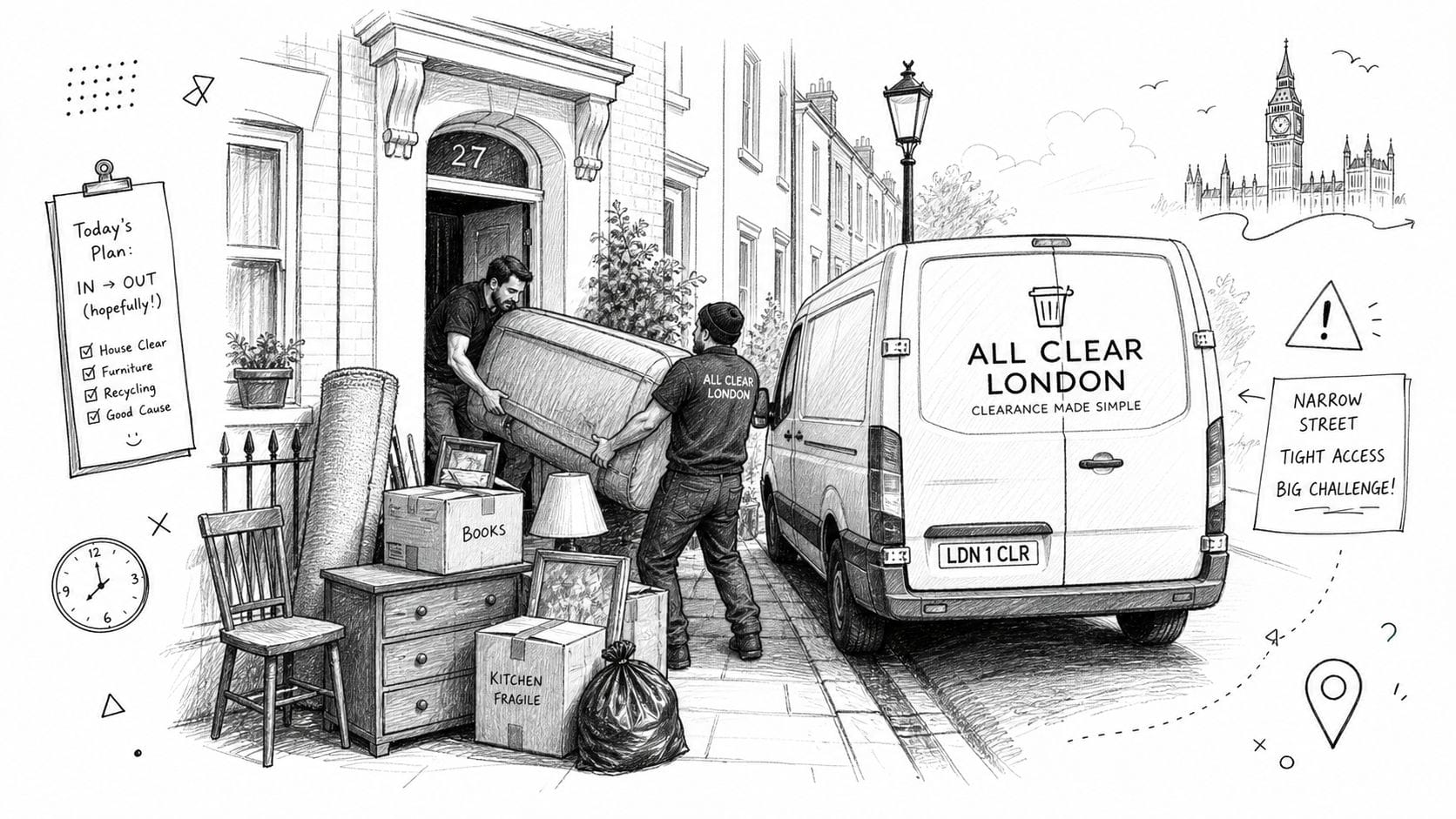
Work through the options in this order
It’s tempting to default straight to “just get rid of it,” but working through these in sequence usually saves money and keeps more items out of landfill:
- Sell it. If it has resale value, this is free to you and often quicker than people expect.
- Donate it. If it’s in good, usable condition but not worth the hassle of selling.
- Recycle it. For electronics, appliances and materials your council or a specialist recycler can process.
- Council collection. For bulky household items that can’t be sold, donated or easily recycled yourself.
- Pay for professional disposal. For anything left over, or when you’re short on time and want it handled as part of the move itself.
1. Try to sell it first
If an item is still in decent condition, selling it costs you nothing and is usually faster than people assume. Facebook Marketplace and Gumtree work well for furniture and appliances; Vinted suits clothing and smaller household goods; eBay is worth it for anything collectable or brand-specific. Price it to move; most people selling ahead of a deadline price slightly under market value, and it shifts within a few days.
Build in lead time. If you’re hoping to sell before moving day, start at least two to three weeks out rather than the week before, so there’s room for a buyer to arrange collection.
2. Donate what’s still usable
If selling feels like too much effort, or the item just isn’t worth listing, donating is the next best option. It keeps the piece in use rather than in landfill and it’s often as simple as booking a free collection.
- Furniture and household goods: The British Heart Foundation, local hospices, and most high-street charity shops accept furniture in good condition and often offer free collection for larger pieces.
- Electricals: Charities can usually only resell electrical items that have passed a PAT (portable appliance) test, so check before donating anything that plugs in, since a working item without a safety check may be turned away.
- Office furniture and equipment: Business-focused reuse networks and some larger charities take desks, chairs, and filing cabinets in bulk, which is worth exploring before an office move rather than defaulting to disposal.
As with selling, donation charities usually need a few days’ to a couple of weeks’ notice for a collection slot, so it’s worth arranging before the final week of your move.
3. Recycle what can’t be sold or donated
Not everything is donatable, but a lot of it shouldn’t go in general waste either. Your local household waste recycling centre (HWRC) will take most furniture, electricals, and appliances for recycling, usually free for household users, though some councils charge for specific categories like mattresses or plasterboard.
Electrical items fall under the UK’s WEEE regulations, which exist specifically to stop electricals being incinerated or landfilled unnecessarily. In practice, this means:
- Large retailers must offer free take-back of an old electrical item when you buy a like-for-like replacement.
- Council recycling centres have dedicated WEEE collection points, separate from general skips.
- Items with a battery or plug should never go in with regular bulky waste.
For an office, this matters more than most people expect: old monitors, printers, and IT equipment are classed the same way and can’t simply be skipped with general waste.
4. Book a council bulky waste collection
For large household items such as sofas, wardrobes, mattresses and fridges that you can’t sell, donate or transport yourself, most UK councils run a bulky waste collection service. It’s worth knowing the rules before you rely on it:
- It’s a household-only service; business, office, and trade waste isn’t accepted through this route.
- Pricing, item limits and waiting times vary significantly by council, and there’s no single national rate.
- Most councils require items to be left at the front of the property or a designated collection point, usually not collected from inside the home.
- Booking is normally online, and collection dates are often fixed rather than time-specific, so you may need to leave items outside overnight.
Book this well ahead of your move date. Waiting lists of one to two weeks are common, and if you leave it too late you’ll be paying for last-minute professional disposal instead.
5. Pay for professional disposal as part of the move
If an item genuinely has to go and none of the above applies in time, a removal company can usually take it away as part of the same job rather than leaving you to arrange a separate collection. This is where our own house removals and man and van jobs often pick up an extra sofa, wardrobe, or a few boxes of things that didn’t make the cut.
There’s a cost to this beyond just fitting it in the van: time getting to the disposal yard and back, plus the yard’s own fee, which is usually charged by weight. Published UK guide prices give a general sense of the range, though the real figure always depends on volume and item type. A reputable company will quote this upfront as part of your removal quote, not add it on after the job’s done.
This is also where the legal side matters, and it’s worth understanding even if you’re not the one doing the disposing.
The legal bit: why it matters who takes your waste
Anyone transporting other people’s waste in the UK, whether a removal firm, a man-and-van operator or a skip company, is legally required to be a registered waste carrier with the Environment Agency (gov.uk). Operating without registration is a criminal offence and can carry an unlimited fine.
What’s less well known is that you carry some responsibility too. UK householders have a duty of care to take reasonable steps to make sure their waste is handed to an authorised person (gov.uk). If you pay someone cheap and cash-only to “take it away” and they fly-tip it, you can be held liable, and householders can face a fixed penalty of up to £600 for passing waste to an unregistered carrier that gets fly-tipped (UK Parliament research briefing). Fly-tipping penalties themselves have just been increased sharply: as of the government’s July 2026 announcement, the maximum fixed penalty for fly-tipping has risen to £5,000, a 400% increase on the previous £1,000 ceiling.
Before handing anything to anyone for disposal, it’s worth checking their waste carrier registration on the Environment Agency’s public register. Best London Removals is a registered waste carrier (Waste Carrier No. CBDU235943), and we’re happy to have that checked before you book.
Office moves: what’s different
Office clearance overlaps with house clearance but adds a few things that don’t come up at home:
- Confidential documents. Anything containing client, staff or financial data needs secure destruction, not a general recycling bin, since this is a GDPR and data-protection issue, not just tidiness. Arrange secure shredding or destruction with a chain-of-custody record before the move, rather than boxing files up “to sort later.”
- IT equipment and data. Old computers, servers, and phones need proper data wiping or physical destruction before disposal, on top of the WEEE recycling requirements covered above. Ask any clearance provider whether they issue a disposal or destruction certificate for compliance records.
- Business waste isn’t covered by council bulky collection. As noted above, council collection services are for households, so an office clearing out desks, chairs and old equipment needs a commercial waste carrier or a removal company that handles it as part of the move.
- End-of-lease timing. Landlords often expect premises returned in a specific condition, so clearance usually needs to be finished and documented (photos, sign-off) before the final walkthrough, not squeezed in afterwards.
If you’re planning an office move, our office removals service covers furniture, IT equipment, and files as part of the relocation, with the same upfront pricing approach described above.
What to do with each item type: quick reference
Sofas, beds, wardrobes (good condition)
Best first option: sell or donate to charity.
Fallback: council bulky collection, or take-away as part of your move.
Mattresses
Best first option: donate, if clean and undamaged.
Fallback: council collection or a specialist mattress recycler, though many councils charge separately for these.
Fridges, freezers, washing machines
Best first option: council collection (WEEE handled separately).
Fallback: retailer take-back on a like-for-like replacement.
TVs, monitors, computers, printers
Best first option: retailer take-back or a WEEE recycling point.
Fallback: professional clearance with a disposal certificate, especially important for offices.
Confidential paperwork and files
Best first option: secure shredding with a chain-of-custody record.
Fallback: none. This should never go in general recycling.
Paint, chemicals, batteries
Best first option: council household hazardous waste point.
Fallback: none. Never place in general bins or standard skips.
Small household items, clothing, books
Best first option: charity shop donation, or resale via Vinted or eBay.
Fallback: council recycling centre.
Flag it before moving day, not on the day
If you already know some items aren’t coming with you, mention it when you book your quote or survey rather than on the morning of the move. Tell the company whether you’re hoping to sell or donate something first, or whether it’s outright disposal, as this affects van space, time and cost, and is far easier to plan for in advance than to work out on the spot. Bulkier pieces are worth flagging specifically; a large corner sofa or an old wardrobe changes how much time and space the job needs. If you’re unsure whether something will clear a doorway or stairwell, this guide to typical sofa dimensions is a useful check beforehand.
If timing doesn’t line up
Sometimes the new property isn’t quite ready for everything, and furniture needs to sit somewhere for a short period rather than going straight to disposal. We don’t run our own storage facilities, but we regularly help clients arrange this through storage partners, assessing volume, advising on unit size and handling the move in and out. Our storage units in London guide covers how that works in full.
Getting it sorted as part of your move
Disposal isn’t a separate service with its own pricing structure, it’s something we build into your normal home removal, office relocation or man and van quote. Mention any items you want taken away when you get in touch, and we’ll price it in alongside the rest of the job.
If you’re planning a move and have a few things you won’t be bringing with you, request a free quote and let us know what needs to go. We’ll factor it in from the start.
Frequently asked questions
Can removal companies take away unwanted furniture during a move?
Yes, most can, though it’s usually an add-on to the removal job rather than a separate service. It should come with an upfront cost that covers the time to reach a disposal yard and the yard’s own fee, and the company should be a registered waste carrier. Confirm this when you book rather than assuming it’s included.
Do I have to pay for council bulky waste collection?
It depends on your council, some offer a free annual collection, others charge per item or per collection. There’s no national standard rate, so check your local authority’s website before assuming a price.
Is it illegal to leave furniture on the street for someone to take?
Leaving items on public land for anyone to take, rather than a booked collection, can count as fly-tipping and carries a fixed penalty of up to £5,000 in England as of mid-2026. Always use a booked council collection, a registered carrier, or a charity collection rather than leaving items out speculatively.
Can I donate electrical items that need a small repair?
Generally no, most charities can only resell electrical items that have passed a PAT safety test, so a faulty item is usually turned away even if the fault is minor. Recycling via a WEEE collection point is the better route for anything not in full working order.
How do I check a company is a legitimate, registered waste carrier?
You can search the Environment Agency’s public register of waste carriers by name or registration number before booking. Any company that removes waste on your behalf should be able to give you their registration number without hesitation, and Best London Removals’ number is CBDU235943.