


A move in London rarely goes wrong because someone forgot a cardboard box. More often, the trouble starts when the new keys are collected, the van is outside, and a forgotten address still sits on a vehicle record, council tax account, insurance policy or business letterhead. A missed update can mean returned post, incorrect billing, vehicle compliance problems or delays with official correspondence.
A well-organised change of address treats administration as part of the move itself, not as an afterthought once the boxes are unpacked.
Why a change of address matters more than most movers realise
A household can leave a flat in Ealing in the morning and arrive in a different borough by the afternoon, yet several organisations may still hold the old address for weeks. The bank may send a replacement card there, the council may continue billing the old property, and a vehicle record may remain linked to the previous home. If the move involves a family, a flat-share or a small business, different people and trading names may need separate updates.
The scale of residential movement in England is substantial. The 2021 Census recorded 5.9 million people with a different UK address one year before Census Day, representing 10.1% of usual residents aged one and over. That included 3.2 million people who moved within the same local authority and 2.8 million who moved to a different local authority. In London, where a short journey can cross a borough boundary, many moves fall into that second category, which means closing one council account and registering with another.
Practical rule: treat the old address as an active administrative risk until post, accounts, vehicles and council records have all been checked and updated.
The common mistake is to write one long list called “notify everyone” and work through it randomly. That approach gives the same priority to a streaming subscription and a vehicle log book. A more reliable method puts legal and financial records first, arranges mail protection around the move date, and leaves lower-risk subscriptions until the main records are secure.
When to start your change of address
The correct notification date varies by organisation. A utility provider may need a final meter reading when the household leaves. DVLA records should change when the keeper moves. Council tax needs a closing date for the old home and an opening registration at the new one. Sending every notification at once often creates confusion rather than solving it.

Before the move
Begin with organisations that need processing time or that control access on moving day. Confirm the removal date with the landlord, managing agent or conveyancer. In London, arrange any required parking suspension with the destination borough in advance, and book a goods lift or loading bay with the building if its rules require one.
Arrange Royal Mail redirection before leaving, but treat it as a temporary safeguard rather than a replacement for changing individual accounts. Personal redirection can forward post to a UK or overseas address for three, six or twelve months. Prices start from £45.00 for one person for three months, rising to £95.00 for twelve months. Two adults moving together each need their own redirection. From June 2025, redirected post is processed as second-class, so it will take slightly longer than first-class post sent directly to the new address. Royal Mail personal redirection
Apply at least five working days before the move date, and ideally earlier. The service can be set up online or through a Post Office branch.
On the move date
Record meter readings at the old property, photograph the meters and note the condition of both homes. Provide the old and new councils with the relevant dates, and keep final readings, tenancy documents or completion papers available if a council or utility provider asks for evidence.
Update insurers and utilities according to their own procedures. Home insurance usually needs the new risk address from the point when responsibility for the property begins. The removal team also needs workable access, including lawful parking, lift access and any building entry arrangements.
Immediately after arrival
Once the new address is occupied, change records that depend on actual residence. Prioritise HMRC, DVLA, banks, employers, healthcare providers, student finance, benefits services and the electoral register. This order reduces the risk of assuming that redirected post has changed the underlying account.
Redirection has its own requirements. The service requires the names and dates of birth of everyone whose post is being redirected, plus the old and new addresses and postcodes. It is person-based rather than address-based, so an omitted occupant remains uncovered. Check this carefully in flat-shares and families with different surnames. Post Office redirection requirements
Who to notify when moving in London
A practical priority system is more useful than an alphabetical directory. Records that affect legal compliance, money or access come first. Communication and convenience accounts follow once the core address has been secured.
Highest priority records
DVLA: The driving licence, vehicle log book (V5C) and vehicle tax Direct Debit are all treated as separate records by DVLA, and each requires its own update. Changing the driving licence does not automatically update the V5C, and vice versa. Both can be updated online for free via GOV.UK. If vehicle tax is paid by Direct Debit, that address must be updated separately by calling DVLA. Updating a driving licence is a legal requirement. Failing to keep the V5C address current can result in a fine of up to £1,000. DVLA change of address guidance
HMRC: Change the address in the personal tax account. This matters for tax records, correspondence and identity checks. Anyone receiving benefits or managing immigration-linked administration should also check whether the address is recorded separately in those systems.
Benefits and student finance: Universal Credit, housing benefit and student finance may use address information for eligibility, payment or correspondence. Students should check each organisation separately, since a home address, a term-time address and a permanent address can each be required in different fields depending on the organisation.
Immigration records: Anyone with an ongoing UKVI process should check the address requirements for that process rather than assuming post redirection is sufficient. An old address can create a serious communication risk where an organisation expects prompt notification.
Council and property records
The old and new local authorities need accurate move dates. London borough boundaries are not interchangeable, even when two properties share a nearby postcode or sit close to the same transport route. A household moving from Hillingdon to Ealing, for example, needs to close the former account and register with the new authority.
Council tax guidance recommends notifying both councils within 21 days of moving, reporting the move-out date and registering the move-in details at the new address. Council tax change-of-address guidance: For a borough-focused explanation of closing and opening accounts, see the council tax moving guide.
Financial and contractual organisations
Banks, credit card providers, mortgage lenders, insurers and pension administrators should be updated once the new address is confirmed. Insurance providers need the correct property details for home, contents, buildings, vehicle and landlord policies. Employers and payroll teams need the new home address for payroll records, workplace correspondence and benefits administration. Healthcare providers, dentists and pharmacies should be updated where the practice or delivery service relies on the home address.
Household services and communication
Notify electricity, gas, water, broadband, mobile, security, and waste-related providers. Take meter readings at the old and new properties and keep confirmation emails. Subscriptions, online retailers and delivery apps can wait until the core records have been changed, but they still matter if regular deliveries could arrive at the former address.
The electoral register should be updated through the appropriate local authority process. This is separate from changing a bank record or using Royal Mail redirection, so it needs its own check.
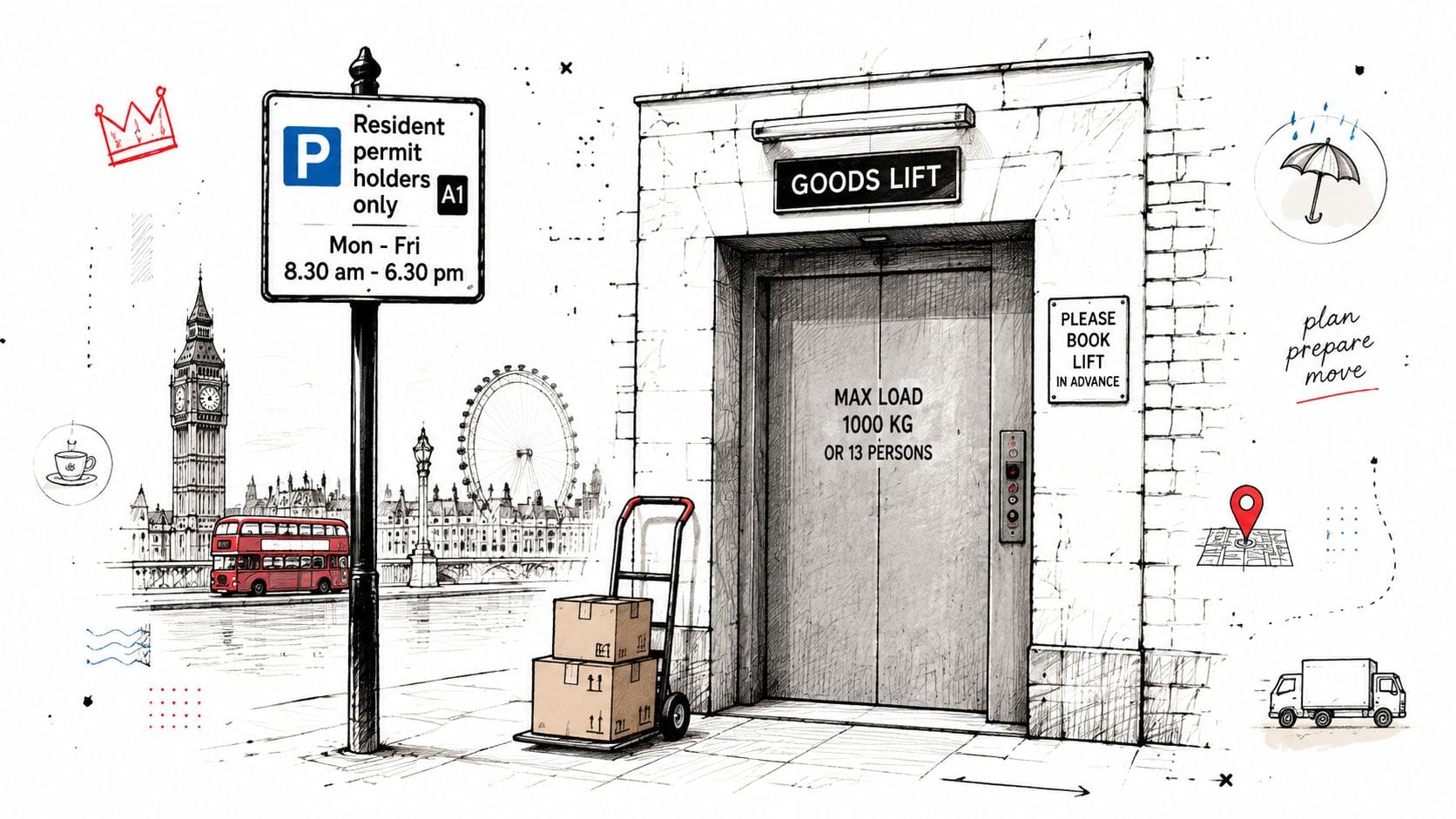
A removal booking can be correct on paper and still fail operationally if the building has no reserved lift slot or the van cannot legally occupy the road outside.
Templates and sample wording for common notifications
Short, complete messages reduce omissions. Each notification should state the account holder’s name, old address, new address, effective date and any account or reference number. Organisations may ask for verification separately, so sensitive information should only be provided through their secure portal or an established contact channel.
Council tax
Subject: Council tax change of address
Account holder: [full name] Council tax account: [reference] Old address: [full address and postcode] Move-out date: [date] New address: [full address and postcode] Move-in date: [date]
Please close the council tax account for the old address and register the new address from the move-in date. Please confirm whether any further evidence is required.
Send the old and new boroughs separately if the move crosses a council boundary. Do not assume one council will notify the other.
Employer or payroll team
Subject: Change of home address
Please update the employee record for [full name], employee number [number], from [old address] to [new address]. The new address applies from [date]. Please confirm whether payroll, benefits or HR records require separate updates.
This wording keeps the request focused and avoids sending unnecessary identity documents by ordinary email.
Bank, insurer or service provider
Subject: Address update for account [reference]
The correspondence address for [full name or business name] should change from [old address] to [new address] with effect from [date]. Please confirm when the change has been applied and whether any policy, billing or delivery arrangements are affected.
For a small business, list each trading name and recipient set separately.
Landlord or managing agent
Subject: Move-out and forwarding details
The property at [address] will be vacated on [date]. The forwarding address is [address], and the preferred contact details are [email and mobile]. Please confirm the check-out appointment, key-return arrangements, meter-reading process and deposit correspondence address.
A tenant should retain a copy of every notification, along with delivery confirmations and photographs taken on the move date.
London-specific considerations for movers
London moves involve local rules that sit outside the ordinary address-change process. Parking controls, building access and borough administration can decide whether furniture reaches the front door without delay. A postcode is useful for finding a property, but it isn’t enough to identify the authority responsible for a parking suspension or council service.
Parking suspensions need the correct borough
A van occupying a resident-only bay or controlled parking space may face a penalty notice or removal unless the space has been legally suspended in advance. The application goes to the exact borough authority responsible for that road, not necessarily the council that appears most familiar from the postcode or a nearby landmark.
Applications can take several working days to several weeks depending on the borough, and some take up to four weeks. A late application may leave the removal team with no lawful loading space, forcing a longer carry, a delayed arrival or a rebooked move. The London parking suspension guide explains why the correct authority must be identified before the application is submitted, and what the request should include.
Buildings add another timetable
Flats in Canary Wharf, Islington, Wembley or central London developments may require a booked goods lift, loading bay reservation, concierge notification or protective floor covering. Some buildings restrict move-ins to set time windows, while others require a named contact and proof of insurance from the removal company. The managing agent or concierge should confirm the rules in writing, because a removal team cannot assume a passenger lift is available for large furniture.
A walk-through should identify narrow turns, security gates, height restrictions and the distance between the legal parking point and the entrance. These details affect vehicle choice, crew planning and the time allowed for loading and unloading.
Borough tax records are separate from physical access
Council tax is administered by the local authority, while parking applications may go to a different team within that authority. A move from Richmond upon Thames to Wandsworth therefore involves separate council tax administration and a fresh review of parking arrangements, even if the distance is short.
The practical approach is to keep a simple file for each address containing the council name, parking application confirmation, building contact details, lift booking reference and move dates. That prevents the common assumption that one London-wide process exists for any of this.

Special situations and costs
Students and shared flats
A student may keep a family address while using a term-time room and temporary accommodation between tenancies. University records, student finance, banks and healthcare providers can each ask for a different address type. Check each organisation separately, record the relevant tenancy dates, and follow any requirement for an immediate update.
Students do not need to update DVLA if living away from home during term time, provided they can still be contacted at their permanent address.
Shared flats need each adult to manage their own records, while one person coordinates the redirection details. Royal Mail’s application requires the names and dates of birth of everyone covered. List every adult occupant, including people with different surnames or separate rooms, because separate correspondence can otherwise leave one person’s post at the old address.
Landlords and agents
A landlord should keep the property address separate from the correspondence address. The managing agent, insurer, mortgage provider, deposit scheme and maintenance contractors may each hold different records. Tenants need clear move-in instructions covering council tax responsibilities, meter readings, keys, access codes and emergency contacts.
Complete the inventory at the agreed handover point and retain photographs with the tenancy records. The landlord’s address update does not replace the tenant’s responsibility to register at the new home.
Small businesses moving office
Business mail needs its own process rather than being added to a personal redirection request. Royal Mail’s business redirection service can run for three, six or twelve months, continue for up to four years in total, and requires at least five working days to set up after receipt of the application. Royal Mail business redirection guidance
List each trading name, recipient group and destination address. Suppliers, customers, insurers, Companies House, HMRC business records, payroll providers and payment services may require separate updates. Staff should remove the former address from invoices, email signatures, delivery instructions and website contact pages before the office move.
Costs that need a place in the plan
Personal redirection starts at £45.00 for three months for one adult, rising to £95.00 for twelve months. Check the current personal redirection terms before applying, as the service conditions and charges should be confirmed at the time of booking. Where two or more adults need redirection, each person requires a separate application at the per-person rate.
Other costs may include a borough parking suspension, building access fees, lift protection, storage, replacement keys and extra removal time where the vehicle cannot stop close to the entrance.
Insurance should be checked before goods travel between addresses. The removal booking should confirm what cover applies and whether valuable, fragile or unusual items need separate treatment. The guide to goods in transit insurance sets out the protection questions households and businesses should raise before collection.
Final checklist and next steps
The change of address is complete only when the old account is closed, the new account is open, and the records that carry legal or financial consequences have been updated. The final review should confirm:
- Council tax: both boroughs have the correct move-out and move-in dates.
- Vehicles: DVLA has the driving licence, V5C and vehicle tax Direct Debit updates recorded separately.
- Mail: every adult or business recipient is included in the redirection request, with the correct name and date of birth.
- Access: parking permission, goods lift bookings and concierge arrangements are confirmed in writing.
- Services: utilities, broadband, insurance and healthcare records show the new address.
- Work and study: employer, payroll, university, student finance and benefits records are checked.
- Evidence: confirmation emails, meter readings, photographs and reference numbers are stored together.
The moving house checklist covers the physical preparation side, but address administration still needs its own dated record. A removal company handles the transport and access planning, while the household remains responsible for updating official and financial accounts.
Best London Removals can coordinate home and flat removals, packing, furniture dismantling, goods lifts and London parking requirements as part of a properly surveyed move. Contact us to arrange a video walkthrough or in-person survey and receive a clear written quotation for the move.