

Man viewing increasingly filled storage units

Storage unit West London: a practical guide

Finding the right storage unit in West London involves more than comparing unit sizes and monthly prices. This guide covers what to look for, what it costs, and how to plan the access and logistics that London moves almost always involve.
12 min read
July 22, 2026
Reviewed by Ivelin Donchev, Co-Founder, Best London Removals Ltd

A lot of people start looking for a storage unit in West London when a move has already become awkward. The buyer wants the keys before the new place is ready. A landlord in W4 needs the flat cleared sooner than expected. A family in Richmond is downsizing and suddenly realises the new house will not take every wardrobe, bike, archive box, and spare chair on day one.

That is why the usual advice about "pick a size and compare prices" is not enough in this part of London. In boroughs such as Ealing, Hammersmith, Hounslow, Hillingdon, and Richmond, important considerations often sit outside the unit itself. Parking rules, building managers, lift bookings, loading bays, and notice clauses can turn a simple storage plan into an expensive one if they are missed.

Finding your reason for needing storage

A storage unit in West London usually enters the picture for practical reasons, not lifestyle ones. A sale completes in Ealing before the onward purchase in Chiswick. A tenant leaves a flat in Hammersmith but cannot move into the next place for another week. A homeowner in Richmond clears rooms before decorating, then finds the work takes longer than the builder first suggested.

Storage also becomes useful when the move itself needs splitting into stages. That happens often with probate clearances, relationship changes, inherited furniture, or a temporary move into a smaller flat while renovations are underway. In West London, where many homes have limited hallway space, tight staircases, or restricted parking, storing part of the load first can make the final move more manageable.

Common West London situations

  • Gap between properties: The old address must be emptied before the new one is ready.
  • Downsizing: Larger items need time before a decision is made to keep, sell, or donate them.
  • Decluttering for viewings: Extra furniture comes out so rooms in postcodes like W3 or W6 look cleaner and easier to market.
  • Student moves: Term dates and tenancy dates rarely line up neatly.
  • Business overflow: Stock, files, and equipment outgrow a back office or spare room.

The key is knowing whether storage is solving a timing problem, a space problem, or an access problem. That answer shapes almost every other decision, from unit type to how the loading is booked.

Storage works best when it is treated as part of the move plan, not a last-minute overflow area.

Someone storing for a short gap between properties needs flexible dates and quick access. Someone storing inherited furniture for an open-ended period needs stronger packing discipline and a clearer contract. Someone emptying a fourth-floor flat in Shepherd's Bush needs to think about lifts, loading windows, and who is allowed on site before even booking the unit

 Choosing the right size and type of unit

The wrong unit is rarely just an inconvenience. Too small, and boxes get stacked badly, fragile items end up under pressure, and it becomes impossible to reach anything near the back. Too large, and the customer pays for air.

Man viewing increasingly filled storage units

Start with what is actually going in

The most reliable way to judge size is by item type, not by guesswork. Count the major pieces first. Beds, sofas, wardrobes, white goods, desks, dining tables, and bikes determine the footprint far more than soft bags or small cartons do.

A practical sorting method looks like this:

  • Box-heavy loads: Books, kitchenware, clothing, and paperwork stack well, but they become dense quickly.
  • Furniture-heavy loads: Sofas, bed frames, and wardrobes use awkward shapes rather than neat volume.
  • Mixed loads: This is the most common setup during a house or flat move, and it usually needs more access room than people expect.

If access matters, do not pack wall to wall. Leave a narrow walkway and place the boxes that may be needed first near the front.

Match the unit to the item, not just the budget

A standard internal unit suits most household goods if they are clean, dry, and packed properly. That includes boxed clothes, dishes, dismantled furniture, and most household effects.

Some items need more thought:

  • Wooden furniture: Better protected in a stable environment, especially if it is polished, antique, or already sensitive to damp.
  • Electronics: These should be packed carefully and kept away from moisture risk.
  • Paper archives and documents: Worth storing in conditions that reduce fluctuation and accidental damage.
  • Artwork and instruments: These need a provider with clear storage rules and suitable internal conditions.

Climate-controlled space is not automatically necessary for every move, but it matters more when the contents are valuable, sensitive, or staying put for a long period. For routine domestic storage, the bigger issue is often not climate control but whether the customer can load and retrieve safely.

Security and layout matter more than brochures suggest

Look for practical features, not just polished wording. A decent facility should make it easy to understand how entry works, how units are locked, and who is present on site during operating hours.

Useful checks include:

  • CCTV coverage: Ask whether it covers entrances, corridors, and loading areas.
  • Individual unit security: Some facilities use personal padlocks, others use coded systems or alarms.
  • Lighting and corridor width: Important if bulky items will be moved in and out.
  • Lift access: Essential for upper-floor units with furniture, not just boxes.
  • On-site staff presence: Helpful when access issues come up on move day.

If a unit can only be filled by stacking everything tightly to the ceiling, it is probably too small for a move that involves later retrieval.

The best choice for a storage unit in West London is usually the one that fits the load comfortably, allows safe access, and matches the likely duration. Cheap space that is awkward to use often stops looking cheap once the move starts.

Understanding the costs and contracts

The headline monthly price rarely tells the full story. Storage quotes can include promotional pricing, insurance requirements, deposits, notice terms, and billing rules that only become obvious when the customer wants to move out.
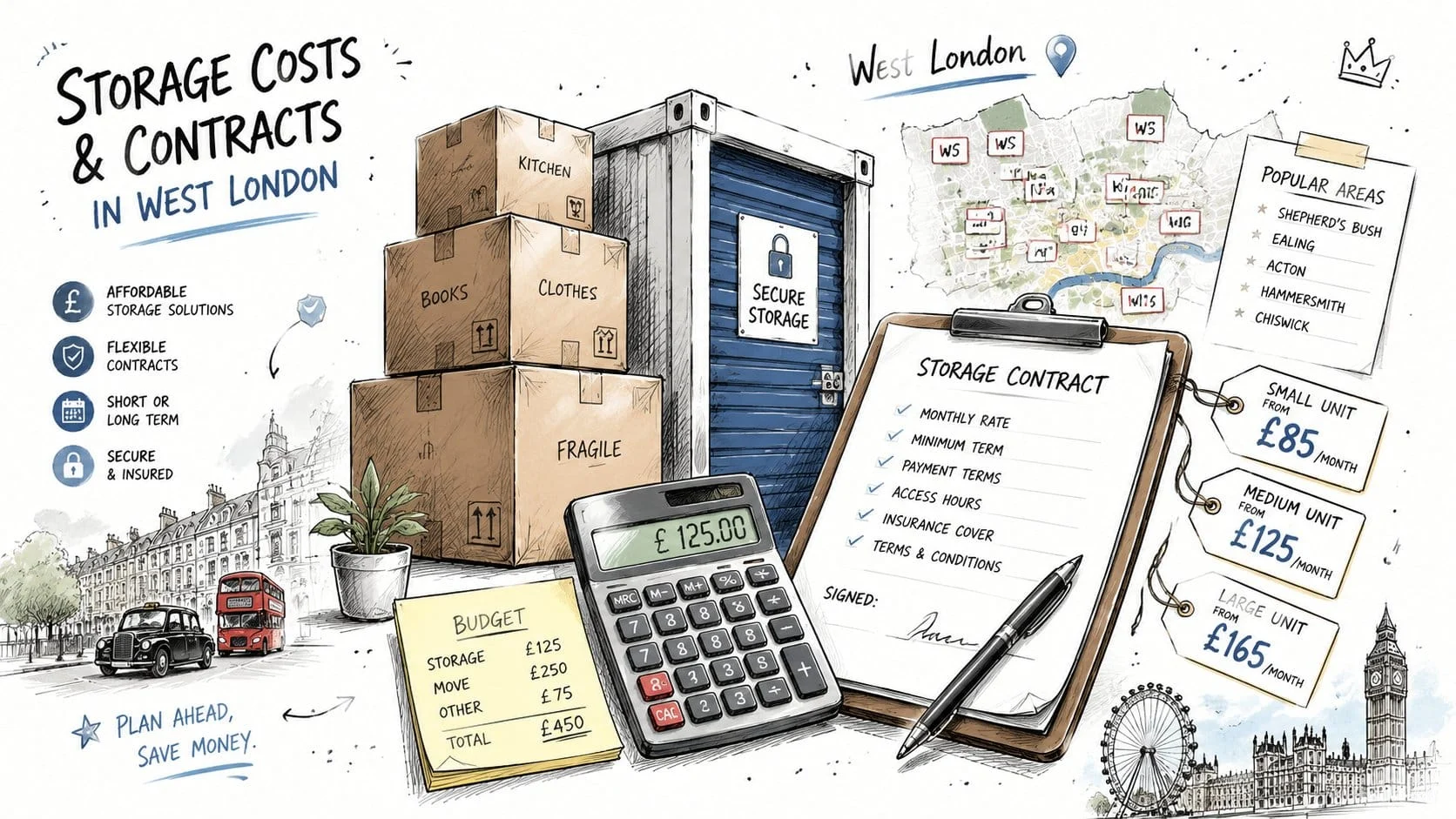
West London storage costs and contract illustration

What West London storage typically costs

Based on Self Storage Association UK 2025 industry data, London-wide averages by unit size (prices inclusive of VAT) are roughly:

  • 25 sq ft (student room, seasonal items): around £110 per month
  • 50 sq ft (studio flat contents): around £220 per month
  • 75 to 100 sq ft (one to two-bedroom flat): around £330 to £440 per month
  • 150 sq ft and above (larger family home or business stock): £500 per month and upward

West London covers a range. Facilities in Hammersmith, Fulham, and Chiswick tend to sit toward the higher end of London pricing due to land costs and demand. Those in Ealing, Southall, Hayes, and outer Hillingdon typically come in lower. Choosing a facility a few stops further from the centre on the District or Piccadilly line can save a meaningful amount over a multi-month storage period.

These figures cover the unit itself. The full cost of a storage move also includes transport to and from the facility, which for most West London home moves ranges from a few hundred pounds for a man and van booking to over a thousand for a larger property with difficult access. For a sense of what the removals side might cost, the London moving cost calculator helps separate the two budgets before comparing quotes.

What usually affects the total bill

Storage itself is only one part of the cost. For the storage contract, ask about:

  • Introductory offers: Useful, but only if the rate after the offer still works for the likely storage period.
  • Insurance: Some providers require cover as part of the agreement. Anyone arranging transport should also check goods in transit insurance for removals and storage moves.
  • Deposits and admin fees: These can change the true first-month cost.
  • Notice periods: A flexible agreement is only flexible if the exit terms are clear.

The clause that catches short-term renters

One of the most overlooked contract issues is the mid-month departure charge. Many people assume that if they leave partway through a month, they only pay up to that date. That is not always how the contract works. Some providers bill for the full month regardless of when the unit is vacated unless a specific clause confirms otherwise.

That matters in West London because a lot of storage use here is short-term and tied to uncertain dates. Students, renters between tenancies, and people waiting on completion dates can all end up paying for time they did not expect to use.

Rolling contracts versus longer commitments

A rolling monthly agreement suits uncertain moves. If a completion date changes or a landlord delays access, the customer is not boxed into a long commitment. The trade-off is that the monthly rate may not be the cheapest available.

A longer-term discount can make sense for archive storage, inherited furniture, or business stock that will not be touched often. It makes less sense when the move-out date could shift.

Ask these questions before signing:

  • If the unit is emptied mid-month, how is the final bill calculated?
  • How much notice is required, and when does that notice period begin?
  • Is any deposit refundable, and on what conditions?
  • Does the quoted rate change after an initial offer period?

A contract is only good value when the end of the agreement is as clear as the start.

Preparing your items with packing and inventory tips

Packing for storage is not the same as packing for a same-day move. The load may sit untouched for weeks or months, and the boxes at the bottom carry the weight of everything above them. That means speed matters less than structure.
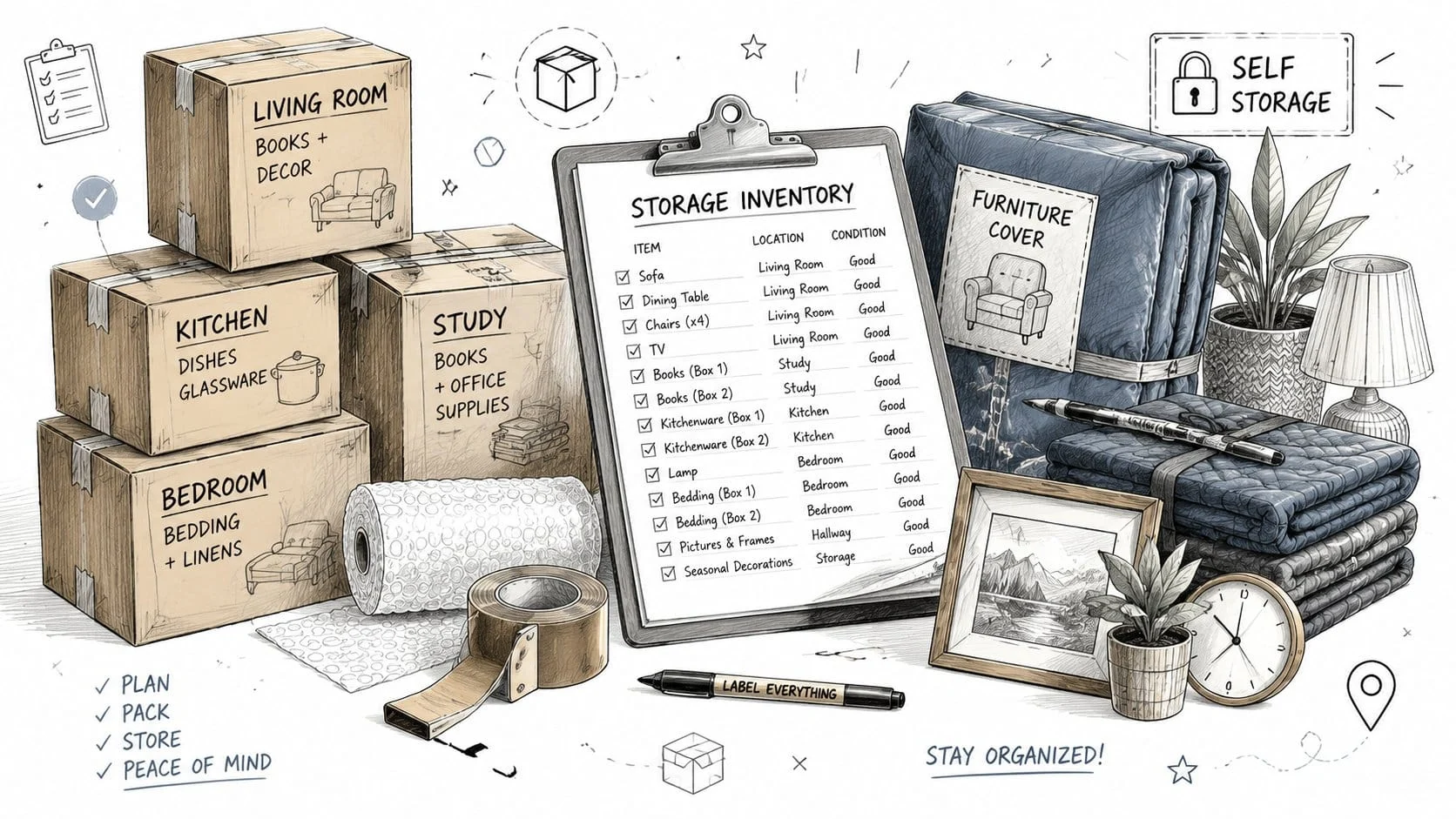
Labelled moving boxes and storage inventory checklist

Pack for stacking and retrieval

Use sturdy, uniform cartons where possible. Mixed supermarket boxes tend to crush unevenly, especially if they carry books, kitchenware, or files. Better materials make stacking safer and the unit easier to organise. For anyone gathering supplies, packing materials for a smooth house move are worth sorting early rather than the night before collection.

A few habits make a big difference:

  • Keep heavy items in small boxes: Books and tools become hard to lift if packed into large cartons.
  • Use wrapping inside the box, not just around it: Empty spaces let items shift.
  • Tape the base properly: Storage boxes often fail from underneath, not on the sides.
  • Avoid overfilling: Lids should close flat without bulging.

Protect furniture and appliances properly

Furniture should be cleaned before storage, then covered with breathable protection where suitable. Dismantling bed frames, tables, and shelving usually saves space and reduces damage at corners and joints. Keep fixings together in sealed bags and attach them securely to the relevant item.

Appliances need extra care. Fridges and freezers should be emptied, defrosted, dried, and left with doors slightly open if they are being stored for a period. Washing machines and dishwashers should be drained properly before transport.

A damp appliance or an unclean drawer unit can cause more trouble in storage than the move itself.

Build a simple inventory that is actually usable

Many users do not need a formal warehouse system. They do need a record they can understand quickly on a mobile while standing at the unit door.

A useful inventory system includes:

  • Room label: Kitchen, bedroom 2, office, loft.
  • Box number: Sequential numbering avoids duplicate “misc” boxes.
  • Short contents line: Enough detail to find the right carton later.
  • Photo log: One image per box face and a few images of assembled furniture before dismantling.

Write on more than one side of the box. If labels only face upwards, they disappear once the unit is stacked. Keep the inventory in notes, a spreadsheet, or even a photo album on the mobile. The method matters less than consistency.

Store frequently needed items near the front. Chargers, paperwork, tools, and seasonal essentials should not be trapped behind a wardrobe and ten archive boxes.

Navigating London logistics for transport and access

Getting belongings to a storage unit in West London is often harder than choosing the unit. Streets are tighter, parking rules are stricter, and many blocks have access policies that do not appear in the tenancy agreement until moving day.

Delivery lorry on London street near Big Ben

CPZ rules can disrupt a move without much warning

In boroughs such as Hammersmith and Fulham, Richmond, Ealing, and parts of Hounslow, parking is not just about finding a bay. Controlled Parking Zones, suspended bays, school streets, estate-managed roads, and timed loading rules can all affect whether the vehicle can stop near the building.

Weekend moves often seem more convenient for work schedules, but controlled parking zones in these boroughs operate on Saturdays and, in some streets, Sundays as well. That can make kerbside access harder to guarantee than people expect, particularly in the busier residential streets of W6, W4, and TW9.

For local parking context in one of the busiest borough setups, guidance around Controlled Parking Zone removals in Ealing shows how much planning can sit behind a short loading window.

Buildings create their own rules

Modern developments in places like Brentford, Acton, and Chiswick often require:

  • Lift bookings
  • Loading bay reservations
  • Concierge sign-in
  • Time-limited move slots
  • Proof of contractor details or vehicle registration

Older conversions bring different problems. Narrow staircases, shared hallways, awkward turns, and limited front access all slow the job down. Some newer developments also use app-based or mobile-linked gate entry rather than a staffed front desk, which means the loading team, the site office, and the storage facility all need to align within the same access window. A customer can choose a very good storage facility and still have a difficult day because the collection building was not planned properly.

The storage contract might be simple. The route from the third-floor flat to the van usually is not.

 DIY transport can work for a small number of boxes from a house with easy parking. It becomes much less attractive when the job involves a flat with timed lift access, a suspended bay nearby, and furniture that needs carrying through communal areas. In West London, logistics is often the deciding factor between a day that runs cleanly and one that turns into extra hire time, rebooking, or a second trip.

Tailoring storage to your specific needs

Not every storage customer needs the same contract, layout, or access pattern. A person between two flats in W6 has a very different set of priorities from a student leaving halls for the summer or a business holding stock near Park Royal.
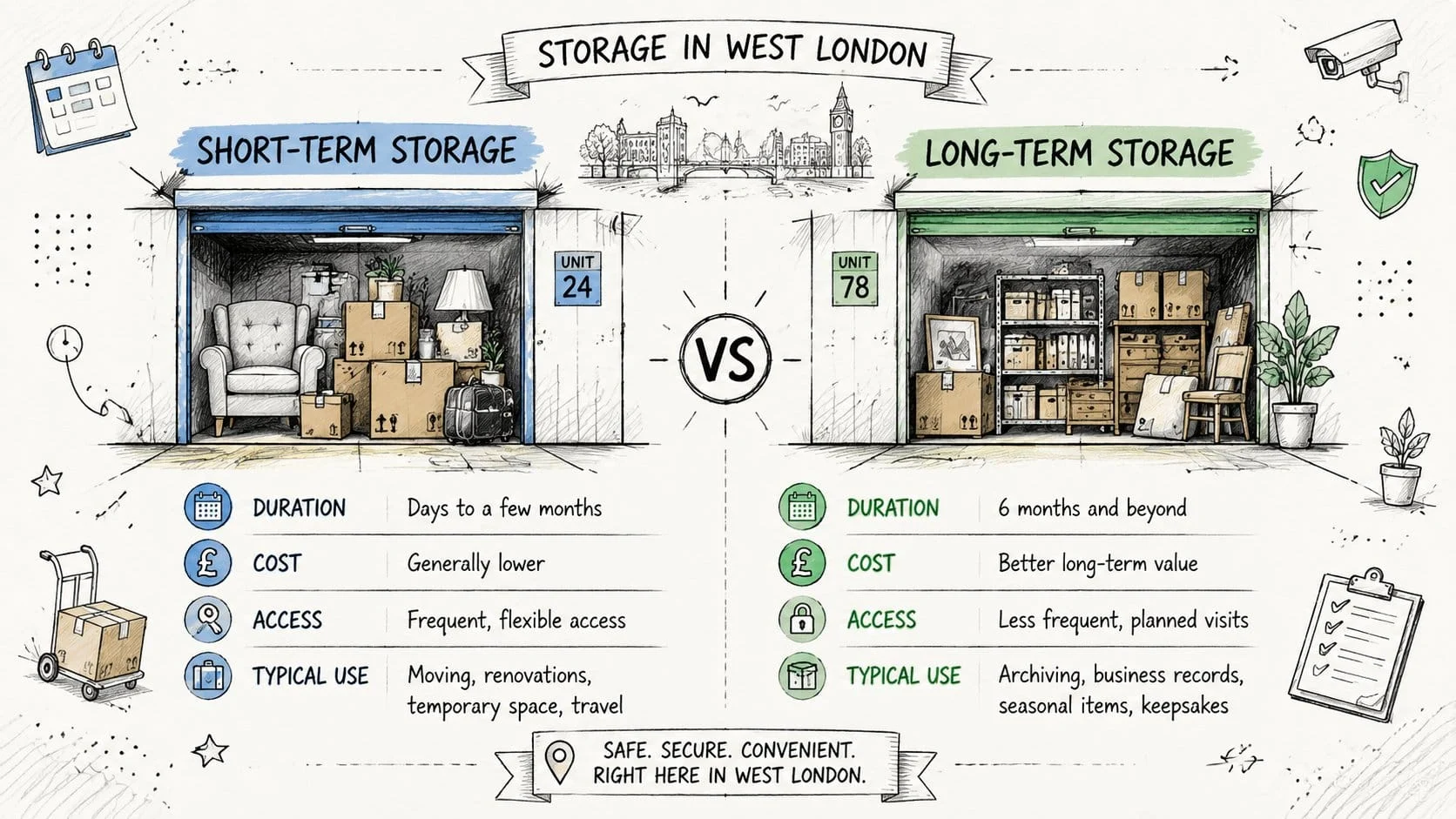
Short-term versus long-term storage in West London

Short-term and long-term storage

Short-term storage suits moves, renovations, and temporary gaps between properties. Access tends to matter more because the customer may need to retrieve items quickly while settling into the new address. The ideal setup is usually a straightforward contract, easy loading arrangements, and a unit that does not require unloading half the contents to find one labelled box.

Long-term storage is more about preservation and organisation. Furniture should be prepared properly, inventory records need to be clearer, and the contract should be checked for renewal terms rather than just move-in convenience. Access may matter less, but packing quality matters more.

Student storage in West London

Students often need storage for practical reasons. Term ends before the next tenancy begins, or there is a summer break between halls and a new rented room. In areas connected to West London campuses and transport links, smaller units usually make more sense than trying to overstore furniture with low replacement value.

A few student-specific checks help:

  • Pick a realistic unit size: Do not pay for furniture that may be cheaper to replace.
  • Keep documents and study materials together: These are often needed first when term restarts.
  • Choose access that matches collection timing: End-of-term moves are usually rushed.

Business storage and operational access

Business use is less about spare belongings and more about workflow. Stock, archived files, tools, marketing materials, and event kit all need different handling. The unit should support repeat visits and clear organisation rather than simple long-term stacking.

For business users, the useful questions are different:

  • Can the facility handle regular access without long delays at reception?
  • Is the route from vehicle to unit practical for trolleys and repeated loads?
  • Will deliveries or collections fit the site’s operating pattern?
  • Is the unit arranged so staff can find items quickly?

A storage unit in West London works best when the facility matches the reason for using it. Trying to force one setup to suit every scenario usually means paying for the wrong kind of convenience.

Final checklist and getting professional help

A good storage plan in West London comes down to a few decisions made in the right order. Choose the unit around the actual contents. Read the contract for the exit terms, not just the move-in offer. Check the building and street access before booking transport. Pack in a way that makes retrieval possible, not just loading fast.


Final checklist before booking

  • Confirm the purpose: Short gap, renovation, decluttering, student move, or business storage.
  • List the major items first: Furniture decides space more than loose bags do.
  • Read notice and billing clauses carefully: Especially if the dates are uncertain.
  • Check access at both ends: The property and the storage site both need workable loading arrangements.
  • Label for retrieval: Numbered boxes and a mobile inventory save hours later.
  • Ask what is not allowed: Do not assume every household item can go into store.

Two last practical questions

What cannot be stored? Each provider has its own prohibited items list. Check that directly before move-in rather than relying on assumptions from another facility.

Do you need your own padlock? Some facilities expect customers to bring one, while others use integrated security systems or sell suitable locks on site. Worth confirming before arrival so there is no delay at check-in.

When collection, transport, and storage need to be coordinated together, local knowledge matters. Best London Removals Ltd, registered with Companies House since 2011 and based in Ruislip, covers all West London boroughs. For anyone combining a move with storage, moving and storage services in London explain how removals and storage can be arranged as one joined-up plan rather than two separate bookings.

Best London Removals Ltd carries out home, flat, and office removals across all London boroughs, with surveys, fixed-price quotations, and access planning included as standard. Smaller jobs are available as man and van hourly bookings, where the team advises a realistic time estimate based on the scope of the work.

Table of Contents
SHARE POST

Latest from the blog

This website uses cookies

We use cookies to personalize content, provide social media features, and analyze our traffic. We also share information about your use of our site with our analytics partners. You can change your preferences at any time. For more information, please see our Privacy Policy and Cookie Policy. Privacy Policy Cookie Policy