


storage service

Long term storage in London: a practical guide

When a move, renovation, or gap between properties means belongings need somewhere safe, this guide covers the options, the costs, and what to get right from the start.
14 min read
July 22, 2026
Reviewed by Ivelin Donchev

A lot of people look for long-term storage at the point when life in London stops fitting neatly into a single move date. A sale completes before the purchase does. A landlord in Fulham wants vacant possession before the next tenancy starts. A loft conversion in Wimbledon turns half the house into a building site. A work posting abroad means a flat in Islington has to be cleared, but not permanently.

That situation is normal. London moves often involve lease dates, parking restrictions, managing agents, probate timelines, renovation delays, and building access rules that do not line up cleanly. Long-term storage is not a last resort in those cases. It is a practical buffer that gives a household room to make sensible decisions instead of rushed ones.

When do you need long-term storage in London?

A common pattern is the delayed purchase. Someone sells in Richmond, expects to complete on a flat in Hackney a few weeks later, then a chain stalls. The furniture needs to leave, but the new address is not ready. Storage bridges that gap without forcing everything into a relative's garage or repeated short-notice van bookings.

Another frequent reason is renovation. In boroughs such as Wandsworth, Hammersmith, and Camden, major works often mean whole rooms need to be cleared for longer than expected. Dust, plaster, moisture, and trades moving through the property can do far more harm than people expect, particularly to upholstered furniture, rugs, artwork, and boxed paperwork.

Illustration of moving home and renovating in London

Situations that come up again and again include:

  • Between addresses: A family leaves SW18 before the new keys in E8 are released.
  • Extended travel: A renter heads abroad for a sabbatical and does not want to keep paying for a larger flat just to house belongings.
  • Probate and inheritance: A property in Harrow or Ealing needs clearing before decisions are made about sale, letting, or distribution.
  • Downsizing: A move from a house to a smaller flat means not everything can come at once.
  • Student and graduate transitions: Belongings need to be held between halls, tenancies, and first jobs.

Long term storage works best when it solves a timing problem. It works badly when it becomes a substitute for making a decision about what's actually worth keeping.

There is also a practical point that does not get enough attention. Some households put items into storage "for now" and then stop reviewing what is inside. The longer the unit sits untouched, the easier it is to keep paying for things that are no longer needed. The best storage plans start with a purpose, a likely timeframe, and a rough exit plan.

Understanding your storage options

 A poor storage choice usually shows up months later, not on day one. The same pattern tends to repeat: a unit looked cheap, access sounded flexible, and nobody asked what damp winter air, repeated handling, or a tight contract could do to the contents over time.
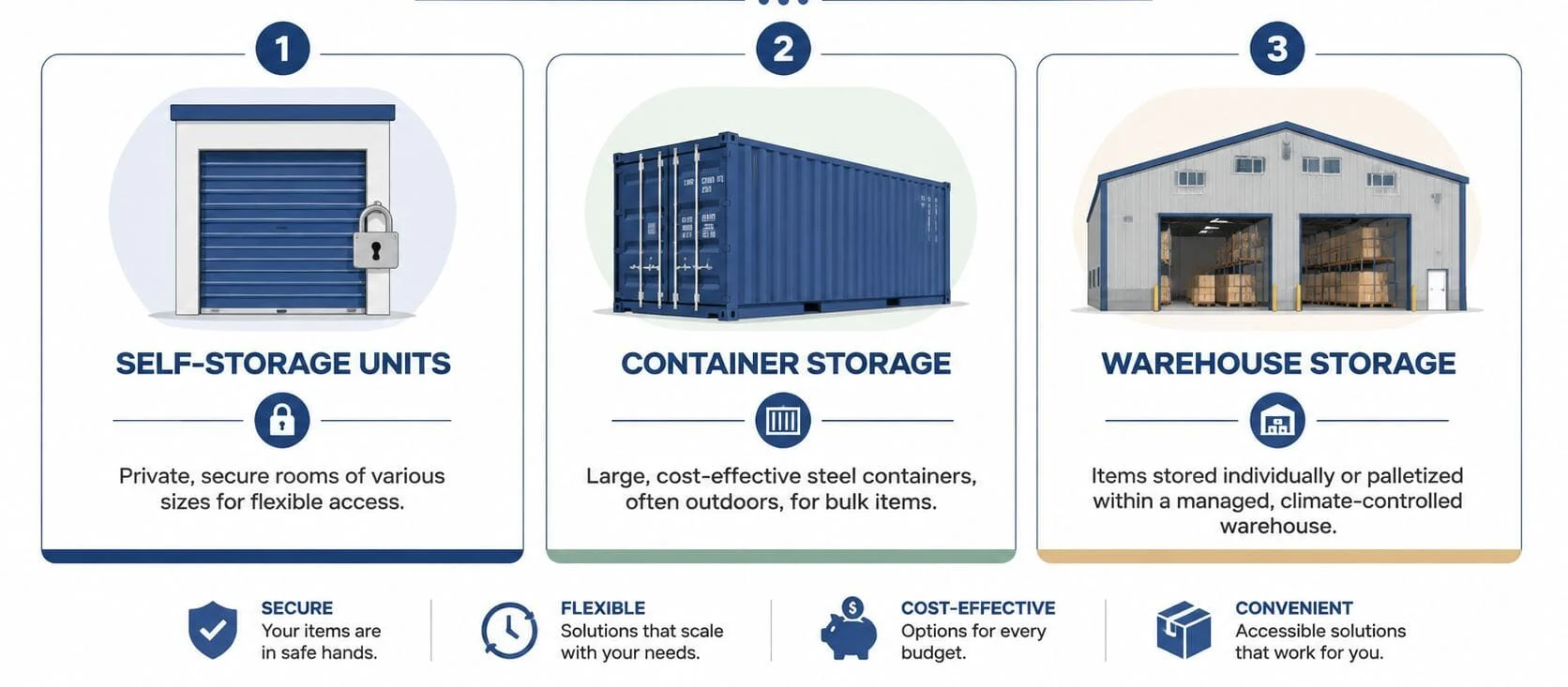
Infographic showing three long-term storage options

The right option depends on three practical questions: how often will you need access, how much handling can the items tolerate, and do the contents need stable conditions rather than basic shelter? In London, where space is tight and many homes are storing between moves, renovations, probate clearances, or overseas postings, those questions matter more than the label on the facility.

Self-storage units

Self-storage gives you a private lockable room and direct access during the facility’s opening hours. It suits households that expect to dip in and out, for example to collect paperwork, rotate seasonal items, or move belongings gradually into a new place.

That flexibility is the main advantage. A homeowner in Clapham or Walthamstow can get to the unit without booking a removals team or waiting for warehouse staff to pull goods out of storage. A practical overview of storage units in London is useful when comparing unit layouts, access arrangements, and what tends to fit in each size.

The downside is that frequent access often leads to poor stacking, broken box sequences, and furniture being moved about more than it should be. For long holds, that extra disturbance is not trivial. It increases the chance of crushed boxes, chipped frames, and items left uncovered after a rushed visit.

Container storage

Container storage works better for bulk storage that will mostly be left alone. This is often a good fit after a full house move, particularly if the aim is to load once and retrieve once.

Space planning is fairly straightforward because container sizes are standard across the market. A 20-foot container is commonly used for the contents of a smaller home or a part-load, while a 40-foot container suits much larger volumes. The key consideration is not just whether everything fits. It is whether the loading plan leaves any realistic chance of reaching specific items later.

That is where people get caught out. If bicycles, garden tools, or archived files are packed behind wardrobes and sofas, access becomes slow and disruptive. Some sites also use outdoor container setups with less stable conditions than customers expect, so asking about condensation risk and ventilation is sensible, particularly for wood, leather, artwork, and paper records.

Managed warehouse storage

 Managed warehouse storage is usually the best match for longer periods where protection and proper handling matter more than casual access. A removals crew collects the goods, inventories them, wraps furniture for storage, and places everything in a warehouse facility designed for stacked, longer-term holding.

This option tends to work well for probate, long overseas assignments, and larger family moves where nobody needs regular access. It also reduces one of the biggest long-term risks: items being badly packed under time pressure and then left for a year in unsuitable conditions.

The trade-off is access and admin. Retrieval often needs advance notice, there may be handling charges for bringing out selected items, and the inventory needs to be accurate from the start. Before signing, the monthly rate is only part of the commitment. Check carefully what access, retrieval, and exit costs look like in the small print.

Which option usually works best

 The choice is usually clearer than it first appears:

  • Choose self-storage if you will need regular personal access and you are prepared to keep the unit organised.
  • Choose container storage if the load is bulky, access will be rare, and the facility can explain how it manages moisture and site conditions.
  • Choose managed warehouse storage if the contents are valuable, the storage period is likely to stretch, or you want professional packing and inventory control.

Climate control deserves more attention than it usually gets. In London, long-term storage failures are often linked to moisture and temperature swings rather than theft. Wooden furniture can shift, leather can dry or mark, paper can absorb damp, and artwork can deteriorate. For anything that would be difficult to replace, ask direct questions about temperature range, humidity control, ventilation, and what the provider will put in writing.

Estimating the cost of long-term storage in London

A London storage quote can look reasonable until the extras start stacking up. The monthly unit price is easy to compare. The parts that cause friction later are often collection costs, insurance, access charges, packing materials, and higher rates for better-conditioned space.

What the average figures look like

 Published market figures are useful for setting expectations, not for choosing a provider. UK storage statistics show that the self-storage sector is heavily concentrated in London and the South East, with average prices typically quoted by square foot and by unit size. Those figures help you spot an outlier quote. They do not tell you what your specific move will cost.

In practice, London pricing shifts for straightforward reasons. A ground-floor unit with long opening hours usually costs more than a less convenient option. A facility inside the North Circular will not price the same way as one farther out. If the building has lifts, loading bay restrictions, narrow booking slots, or limited parking, the removals cost can change as well.

What usually pushes the bill up

The biggest price drivers are often buried in the small print:

  • Location: Inner London and high-demand boroughs tend to charge more than outer areas.
  • Access level: Units with easy, frequent access usually cost more than managed storage with notice periods.
  • Storage conditions: Climate-controlled space costs more, but for long-term storage of wood, leather, paper records, artwork, or electronics, it can prevent far more expensive damage.
  • Length of stay: Some providers offer better rates for longer commitments, while others advertise a low introductory rate and then move on to a higher rolling tariff.
  • Handling and admin charges: Item retrievals, redeliveries, inventory work, and late payment fees can add more than people expect.

A cheap monthly rate is not much of a saving if extra charges apply every time boxes need bringing out, inspecting, or returning. Reading PSL’s guide on storage unit costs before agreeing terms is worth doing to understand what factors typically appear in real quotes.

Budgeting properly before booking

 The safest approach is to price the full job from door to door: the move into storage, the months in storage, and the move back out again.

Include:

  • Storage fee: Monthly or prepaid rate, and whether it changes after an introductory period.
  • Collection and delivery: Van size, crew time, congestion charging, ULEZ, parking suspension, or porterage if the property has poor access.
  • Packing materials: Double-walled boxes, sofa covers, mattress bags, wardrobe cartons, and protective wrapping.
  • Insurance: Usually arranged separately for the contents.
  • Special requirements: Climate-controlled space, document storage, crating, or extra handling for fragile pieces.
  • Exit costs: Notice periods, retrieval fees, and final delivery charges.

For London moves, access is often the hidden cost. A flat in Bloomsbury with no lift, a mews house in Chelsea with nowhere to stop, or a storage site that only accepts arrivals in a two-hour booking window can all change the labour time considerably.

For a quick sense check on the transport side before adding storage charges, the London moving cost calculator helps separate the removals budget from the storage budget, which makes quotes much easier to compare.

Insurance and security

People often assume the facility's insurance covers whatever is inside the unit. It usually doesn't work that way. The building may be insured, but the contents still need their own cover.

Secure storage facility with insurance and CCTV protection

Why storage insurance is not optional

 Most self-storage providers in London require customers to arrange insurance for goods while stored, because standard public liability cover does not extend to the contents inside a unit. Without specific goods cover, customers are exposed to loss from theft or damage.

This matters most when people assume their home insurance will follow the goods automatically. Sometimes it will not. Sometimes it only covers short-term transit. Sometimes there are exclusions for high-value items, business stock, or items left in storage beyond a set period.

What to check in the policy

 A good storage policy should match the actual contents, not a rough guess made in haste. That means checking:

  • Declared value: Underinsuring the contents can cause problems if a claim is needed.
  • Covered events: Fire, theft, escape of water, and accidental damage need to be clearly understood.
  • Item categories: Jewellery, artwork, documents, electronics, and business equipment may have specific limits.
  • Storage conditions: Some policies rely on approved locks, approved premises, or declared packing standards.

Insurance should be arranged from an inventory, not from memory. A rushed estimate often leaves the most valuable items least accurately declared.

For households that want to understand the removals side of cover as well, a guide to goods in transit insurance helps distinguish transport cover from storage cover.

Security features worth looking for

 Security is not just a keypad on the gate. The best setups combine physical barriers, monitored access, and clear site procedures. Useful features include controlled entry systems that limit access to authorised users, recorded CCTV coverage of entrances, corridors, and loading areas, individually secured units with strong, correctly fitted locks, and on-site reception or oversight so access is monitored throughout.

How to prepare and pack items for extended storage

A London storage unit often closes on items for longer than planned. A three-month renovation turns into six. A temporary move abroad becomes a full year. Packing needs to account for that from the start, because damp, trapped moisture, and poor labelling cause far more trouble in month six than on day one.

Start with cleaning and drying

Anything put away dirty or slightly damp usually comes back worse. Crumbs attract pests. Condensation inside boxes leads to mould. Washing machines, fridges, and freezers need to be emptied, cleaned, and left fully dry before storage, with doors left slightly open so stale air does not build up.

Paper files, books, and textiles need the same care. If they go into storage with any moisture in them, they will hold it.

Pack for time, not just transport

Good moving-day packing is not always good long-term packing. Furniture wrapped too tightly in plastic, mattresses stored without proper covers, and document boxes overloaded because the aim was to get everything out of the house quickly — that approach works for a short hold. It causes problems over a long London winter.

Different materials need different treatment:

  • Wood furniture: Clean it, dry it, and avoid forcing it against damp walls. Use padded covers and protect corners.
  • Mattresses and sofas: Use breathable covers rather than trapping them in unsuitable plastic for months.
  • Electronics: Remove batteries where practical, coil cables separately, and keep items in dry, dust-resistant cartons.
  • Books and files: Use small, strong boxes so the weight stays manageable and the cardboard keeps its shape.
  • Metal items and tools: Wipe down and ensure completely dry before packing to reduce surface rust.

Climate control matters more than many customers expect. In London, older buildings, basement spaces, and units with poor airflow can expose contents to temperature swings and damp conditions. Wood can warp, leather can mark, paper can curl, and electronics can suffer from condensation. For anything sensitive or valuable, a climate-controlled unit is the safer choice.

Label for retrieval, not for moving day

A box marked “bedroom” is too vague after eight months. Labels need to say what is inside and whether it is needed urgently, fragile, or safe to stack. “Main bedroom, winter clothes, photo albums” is useful. “Misc” is not.

Keep a simple inventory outside the unit as well. A note on a phone is enough if it is kept up to date. This avoids a lot of unnecessary unloading when one file, one lamp, or a specific box of records is needed later. For businesses storing archive files, spare stock, or equipment, Packaging Panda’s storage box range covers carton options that suit longer holding periods.

Check prohibited items before packing

Items such as perishables, flammables, fuel, weapons, and live animals are commonly prohibited by storage operators, as Snappy Self Storage’s guide to what can be stored covers in detail. If prohibited items go into a unit, the problem is not just potential damage to the goods. It can put the customer in breach of contract.

In practice, this means checking the obvious and the less obvious. Half-used paint tins, petrol left in garden equipment, cleaning chemicals, gas cylinders, and food forgotten in kitchen boxes are common examples. Long-term storage works best when the load is checked before collection day.

Set the unit up so it still works months later

 The layout matters. Leave a narrow walkway. Put the heaviest boxes at the bottom. Keep items that may need access near the front, particularly documents, tools, seasonal clothes, or children's records. If everything is packed floor to ceiling with no order, every visit becomes a partial house move. A little spacing and a clear plan at the start save time, money, and considerable frustration later.

Understanding your storage agreement

The contract matters more than the brochure. People tend to focus on the monthly rate, then discover that access hours are limited, notice periods are stricter than expected, or fees change after an introductory term.

Clauses that deserve attention before signing

Read the agreement carefully and look for the parts that affect everyday use:

  • Access terms: Some facilities offer broad access, others restrict entry to set hours or require advance notice.
  • Price review wording: Introductory offers may end, and the agreement should explain how future increases are handled.
  • Notice to vacate: Leaving usually requires notice, even if the unit is nearly empty.
  • Late payment provisions: Missed payments can trigger restricted access or extra charges.

Many disputes start because customers assume “monthly” means they can leave any day without process. That is not always true. Long-term storage works better when the exit route is understood from the start.

The overlooked issue of over-storing

One of the most expensive mistakes is passive storage, where the unit continues by default because no one reviews it. That's especially relevant in London, where people often move again, travel again, or leave boxes untouched after the original reason for storing has passed.

A practical habit is to diarise a review point before the contract even begins. If the goods still matter after that date, keep them. If not, reduce the unit, remove some contents, or end the agreement properly.

If the storage plan has no review date, the contract can quietly become a subscription to indecision.


One legal point to be clear on

UK law prohibits living in storage units. They are classified for commercial, not residential, use and do not meet legal standards for habitation under the Homes (Fitness for Human Habitation) Act 2018, including requirements for ventilation, sanitation, and fire safety, as Henfield Storage’s legal overview explains. That is relevant during difficult moves, delayed completions, and housing gaps. Storage can protect belongings. It cannot be used as temporary accommodation.

How a removals company can help with your storage

Long-term storage becomes much easier when the move into storage is treated as part of the overall relocation, not as a separate afterthought. Packing standards, inventories, timing, and loading order all affect what condition the goods are in when they come back out.

A removals company handles the parts that usually go wrong when people improvise. That includes protecting furniture properly, dismantling larger pieces, producing a sensible inventory, and loading the vehicle in the order the storage plan requires rather than the order items happen to leave the property.

The biggest difference is made in three areas. During packing, fragile items, framed pieces, lamps, and electronics need more than supermarket boxes and spare duvets. At collection, London access issues matter, particularly in controlled parking zones, mansion blocks, and buildings with booking windows for lifts. Inside the storage unit, the space needs to be stacked for stability, airflow, and later retrieval, not simply filled to the ceiling.

For households combining a home move with storage, moving and storage services in London explain how those logistics can be arranged as one plan instead of several disconnected bookings.

Frequently asked questions about long-term storage

Can items be retrieved unexpectedly?

Usually yes, but it depends on the storage type and the access terms in the agreement. Self-storage is typically easiest for unplanned retrieval. Container and managed warehouse storage can involve more notice, because the goods may be stacked, sealed, or held in a way that is not designed for casual drop-ins.

Can the unit size be changed during the contract?

Often it can, subject to availability and the provider’s process. Downsizing is common after an initial clear-out, while upsizing happens when a move gets delayed and more contents need to go in. It is worth asking how that transfer is handled and whether fresh transport or handling charges apply.

What is the best way to store important documents?

Keep them dry, boxed properly, and easy to identify. Important records should not be mixed loosely with household goods. Use standard document cartons, label clearly, and keep a separate contents record outside the unit.

Is climate control really necessary?

For some contents, yes. It matters most for wood, leather, antiques, artwork, and anything that does not respond well to damp or fluctuating conditions. It may matter less for basic boxed household items that are clean, dry, and well packed. The key is matching the environment to the contents rather than choosing on price alone.

How does a storage agreement usually end?

Most agreements require notice. Some need the account cleared first, and some need the unit left empty and clean before the arrangement closes. Check the exact exit steps at the start rather than assuming the final month will be straightforward.

Best London Removals Ltd carries out home, flat, and office removals across all London boroughs, with surveys, fixed-price quotations, and access planning included as standard. Smaller jobs are available as man and van hourly bookings, where the team advises a realistic time estimate based on the scope of the work

Table of Contents

Latest from the blog

This website uses cookies

We use cookies to personalize content, provide social media features, and analyze our traffic. We also share information about your use of our site with our analytics partners. You can change your preferences at any time. For more information, please see our Privacy Policy and Cookie Policy. Privacy Policy Cookie Policy