


A lot of London office moves start the same way. The lease date is getting closer, the new space looks fine on paper, and somebody in the business assumes the job is mostly desks, screens, and a van.

That's rarely how it works in practice.

An office move in London is a live operational project. Staff still need access to files, directors still need calls to work, building managers want booking forms completed properly, and the vehicle can't stop outside at will because the road looks clear. That's why office removals in London, like most commercial removals in the capital, need tighter planning than a typical house or flat move.

Best London Removals Ltd has handled these projects across the capital since 2011, from smaller team moves in places such as Hammersmith, Ealing, and Croydon to larger relocations into managed buildings in the City and Canary Wharf. Alongside the physical move, many businesses also use the relocation as a natural point to review what furniture and equipment is worth keeping, what can be donated or recycled, and what needs secure disposal. It's worth building that into the plan early rather than discovering it on move day.

A good starting point is choosing a provider that quotes properly after a survey, rather than guessing from a short phone call. This guide on how to choose the best removal company in London helps with that first decision.

Planning your London office move

A London office move usually involves three separate jobs happening at once. One team is thinking about furniture and floor plans, another is worried about internet, printers, and access cards, and somebody else is trying to work out when the removal vehicle is allowed to load outside the building.

That mix is why the move needs to be treated as a coordinated business change, not just transport.
What usually catches businesses out?

The obvious items are rarely the difficult part. Standard desks, meeting chairs, lockable pedestals, and boxed files can all be planned quite easily once the volume is known. The problems usually come from details that weren't checked early enough.

Common examples include:

  • Building restrictions: Some offices in EC2, W1, and SE1 only allow goods lift use during set hours.
  • Shared access routes: A reception lobby may also serve other tenants, which changes loading times.
  • Unplanned IT handling: A business packs general items well, then discovers the server room needs specialist handling.
  • Parking permissions: A legal place to stop the vehicle often needs advance arrangement with the borough.

Practical rule: If the move depends on "sorting it out on the day", the plan isn't finished.

What good planning looks like

A workable office removals London plan starts with a survey, then turns into a written schedule that covers access, responsibilities, order of loading, and delivery placement. That schedule should also match how the business operates. A design studio with shared Macs and fragile displays needs a different approach from a legal office moving archived paper files.

The strongest plans are usually simple. One named client contact, one removal supervisor, clear room labels, and a realistic sequence for what leaves first and what must be reconnected first at the new address.

That doesn’t remove every challenge. It does stop small issues from becoming expensive ones.


Planning your budget and survey for an accurate quote

The quote is where many office moves either become manageable or start drifting.

A proper survey gives the removal team a clear view of volume, access, packing requirements, furniture that needs dismantling, and anything that needs separate handling. Without that, the quote is only a rough guess. In London, rough guesses usually become awkward invoices because time is lost at the loading point, lifts aren't ready, or extra labour is needed for items nobody listed.

Businesswoman reviewing property checklist in London office

Fixed price versus hourly charging

For office work, a fixed-price, itemised quote is normally the sensible option. It gives the business a defined scope and lets both sides agree what's included before move day. That matters when the job includes crate hire, dismantling, packing materials, lift bookings, or staged delivery into more than one floor.

Hourly charging can work for a very small, self-packed move, but it carries more risk. Traffic, delayed key collection, reception bottlenecks, and late access all affect the final cost. Those aren't unusual problems in London. They're normal operating conditions.

What should appear in the quote

A clear office move quote shouldn’t leave the client guessing. It needs enough detail to show how the job has been assessed.

Look for these points:

  • Survey basis: Was the price built from an in-person visit or a video walkthrough, rather than a quick estimate?
  • Scope of labour: Does it say whether the team is packing, loading only, or also dismantling and reassembling furniture?
  • Materials included: Crates, labels, wrapping, and protective covers should be stated clearly if they’re part of the job.
  • Insurance information: Goods-in-transit and public liability cover should be identified, not implied.
  • Access assumptions: If the quote depends on lift access, reserved loading, or a particular move window, that should be written down.

What the survey needs to capture

Managing parking and building access for office relocations

The best surveys are practical, not theatrical. Nobody needs a dramatic site visit. The removal company needs usable information.

That means checking:

  1. What is moving? Furniture, filing, kitchen contents, screens, printers, and any bulky items.
  2. How the team gets it out. Staircases, lifts, corridors, door widths, and reception rules.
  3. What the destination looks like. Delivery floor, unloading route, and whether items are being placed by room.
  4. Which items need special handling? Server racks, comms cabinets, glass tables, safes, or confidential material.


Best London Removals Ltd works on that surveyed basis for fixed-price office quotations, whether the survey is done in person or by video walkthrough. That approach is usually what keeps costs predictable and avoids the “that wasn’t included” conversation later.

Most generic moving advice falls apart at the kerbside.

In London, the loading plan often matters as much as the packing plan. A business might have an organised office and a prepared team, but if the vehicle can't lawfully stop near the entrance, the move slows down immediately. Staff then carry items further, the time on site increases, and building bookings start slipping.

Delivery lorry on narrow street with no-parking sign

Parking suspension and loading bay compliance

This is one of the biggest London-specific costs businesses miss when budgeting. Parking suspensions and temporary loading bay permits vary by borough and street, but they’re real costs that need to appear in the budget before move day, not as a surprise on the invoice afterwards. The removal company should confirm what’s needed for the specific address and include it in the quote.

The process also varies significantly by area. Westminster, Camden, and Kensington tend to involve tighter loading controls and more formal permit requirements than outer borough locations. In Hillingdon or Uxbridge, access patterns can be simpler, but that doesn’t mean assumptions should be made. Every address still needs checking.

For businesses moving through West London, this guide to CPZ rules in Ealing gives a useful example of how local parking restrictions affect removals planning.

Building access is often the second bottleneck

The vehicle is only half the equation. After the team gets to the building, they still need to get through it.

Three points often decide whether the day runs properly:

  • Goods lift booking: Many office buildings won’t allow unrestricted use.
  • Reception protocols: Some sites need contractor details and insurance records lodged in advance.
  • Move windows: Managed buildings may only permit removals early morning, evening, or weekend hours.

If the loading bay is booked but the goods lift isn't, the team is still waiting.

What works better than improvising

The simplest way to avoid disruption is to treat access as part of the quote, not a separate afterthought. The survey should identify whether permits are needed, whether a lift booking is required, and whether the route includes tight corners, shared entrances, or distance from the vehicle to the office floor.

What doesn't work is relying on assumptions such as "the driver can wait on double yellows for a bit" or "security should let the team through if it's quiet". London buildings and boroughs don't run on that basis, and the move shouldn't either.

A practical guide to packing office furniture and IT

Packing an office well is mostly about sequence and identification. If every crate is filled but nothing is labelled usefully, the destination office becomes a pile of guesswork. If furniture is dismantled without keeping fixings organised, reassembly takes longer than it should.

A good packing plan separates ordinary working contents from high-risk equipment and handles them differently.

Furniture, files, and general contents

Start with the non-essential items first. Archive files, spare stationery, meeting room contents, and storage cupboards can usually be packed before the final week. Day-to-day desks are better left until the last stage, so staff can keep working.

Useful packing habits include:

  • Colour by department: Finance, sales, directors, and operations should each have a clear label colour.
  • Number crates by room: “Floor 3, Meeting Room B” is more useful than “misc”.
  • Bag small fixings separately: Desk bolts, cable trays, and monitor arms should stay with the item they belong to.
  • Use proper materials: Strong crates and board cartons protect files and stack more safely than mixed, reused packaging. Office-grade crates are worth using rather than repurposing whatever boxes are to hand.

IT equipment needs a separate plan

Office moves often become expensive, not because the equipment is unusual, but because it’s treated like standard contents until the last minute.

Monitors, desktops, docking stations, printers, phones, and peripherals should be packed by workstation or by team so they can be placed and checked quickly at the new site. Cables should be bundled and identified before disconnection. Anti-static protection and dedicated computer crates make a real difference here because they reduce handling risk and speed up unloading.

Server relocation is a different category again. Certified server handling is typically charged separately and involves different labour, specialist equipment, and transport conditions. The cost varies considerably depending on the size of the installation, the distance involved, and whether climate-controlled transit is required. It’s worth getting a separate line item for this rather than having it absorbed into a general quote.

Businesses comparing options for specialist tech handling can also review this page on IT and office removals in London.

Scheduling your move for minimum business disruption

The cheapest move window isn't always the least costly for the business.

If a company relocates during trading hours and loses access to phones, desktops, or client files for a full working day, the savings on the removal slot may disappear quickly. The smarter question is usually not "Which day costs less?" but "Which schedule protects operations best?"
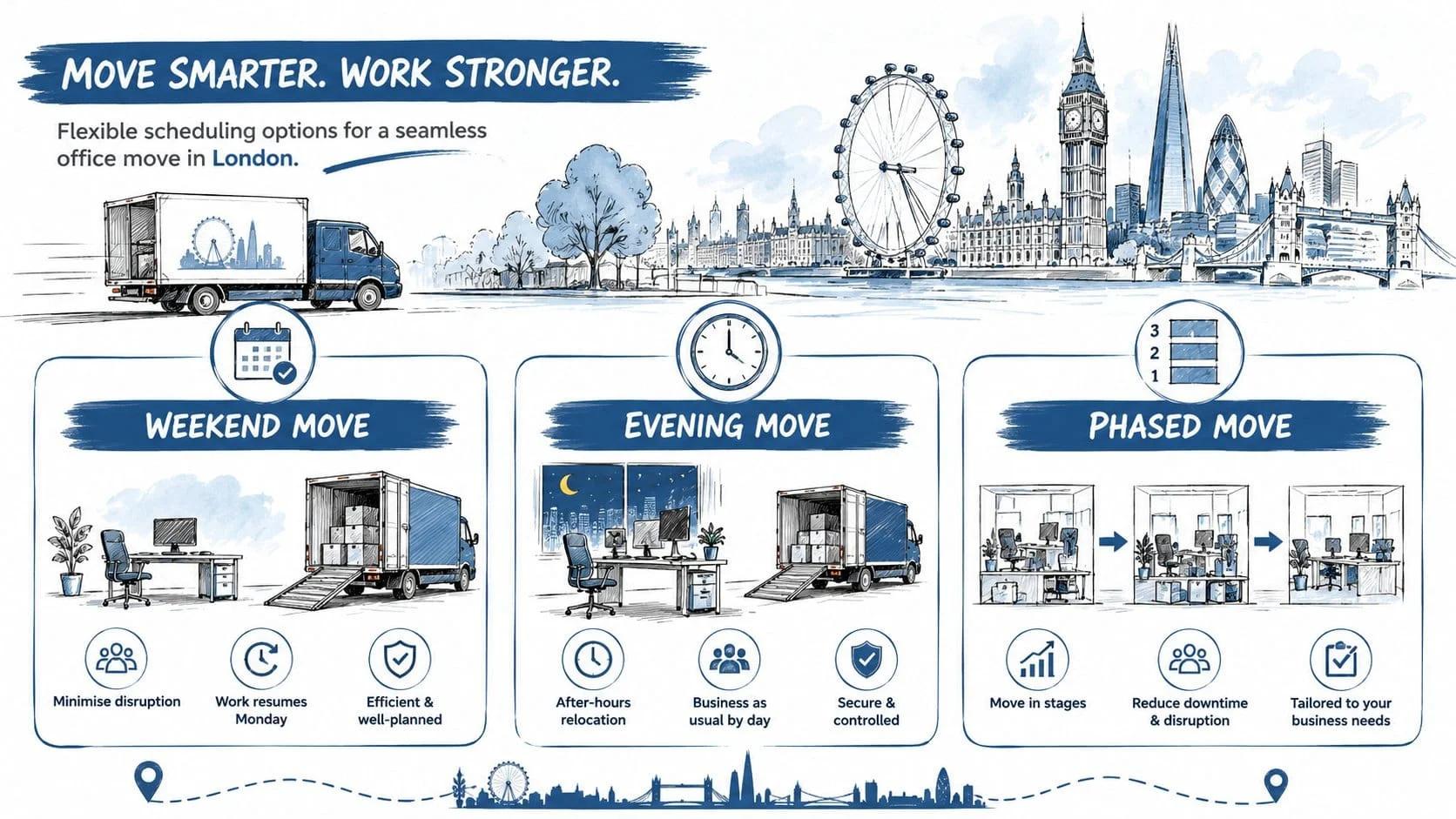
London office move options infographic with truck

Why weekend and out-of-hours moves work

For many offices, Friday evening into the weekend is the cleanest pattern. Staff finish the week in the old office, the removal team packs and loads once desks are clear, and the destination can be set up before Monday morning. That gives IT teams and facilities contacts time to check layouts, test connections, and resolve any room-by-room issues before the business opens again.

Evening or night moves can also work well for smaller offices with fewer people and a simple setup. They suit businesses in serviced buildings where daytime loading is difficult or where front-of-house areas are too busy during normal hours.

When a phased move is the better decision

Some businesses shouldn’t move everything at once. If a department must stay live, or if archive, comms, and people need to move in a controlled order, a phased approach is usually safer.

This tends to suit:

  • Operational teams with live client work: One department moves while another remains active.
  • Businesses with mixed furniture and storage needs: General office contents can move first, archived items later.
  • Sites with limited lift access: Smaller waves reduce congestion in the building.
  • Offices with shared infrastructure: Comms rooms and server areas can be handled in a separate controlled slot.

What usually causes unnecessary downtime

A rushed timetable often creates the same three problems. Staff are asked to pack too late, access bookings don't match vehicle arrival times, and the destination office isn't ready for placement. Then the move finishes physically, but the business still can't operate properly.

The move isn't complete when the last crate comes off the vehicle. It's complete when the team can work.

That's why scheduling has to include not only transport but also placement, reassembly, reconnecting key equipment, and post-move checks.

What to expect on moving day and post-relocation

A well-run moving day should feel controlled, not frantic. The team arrives with the agreed vehicle size, protective materials, and the move sheet already matched to the survey. One supervisor should be the main contact so the client isn't answering the same question from different people throughout the day.

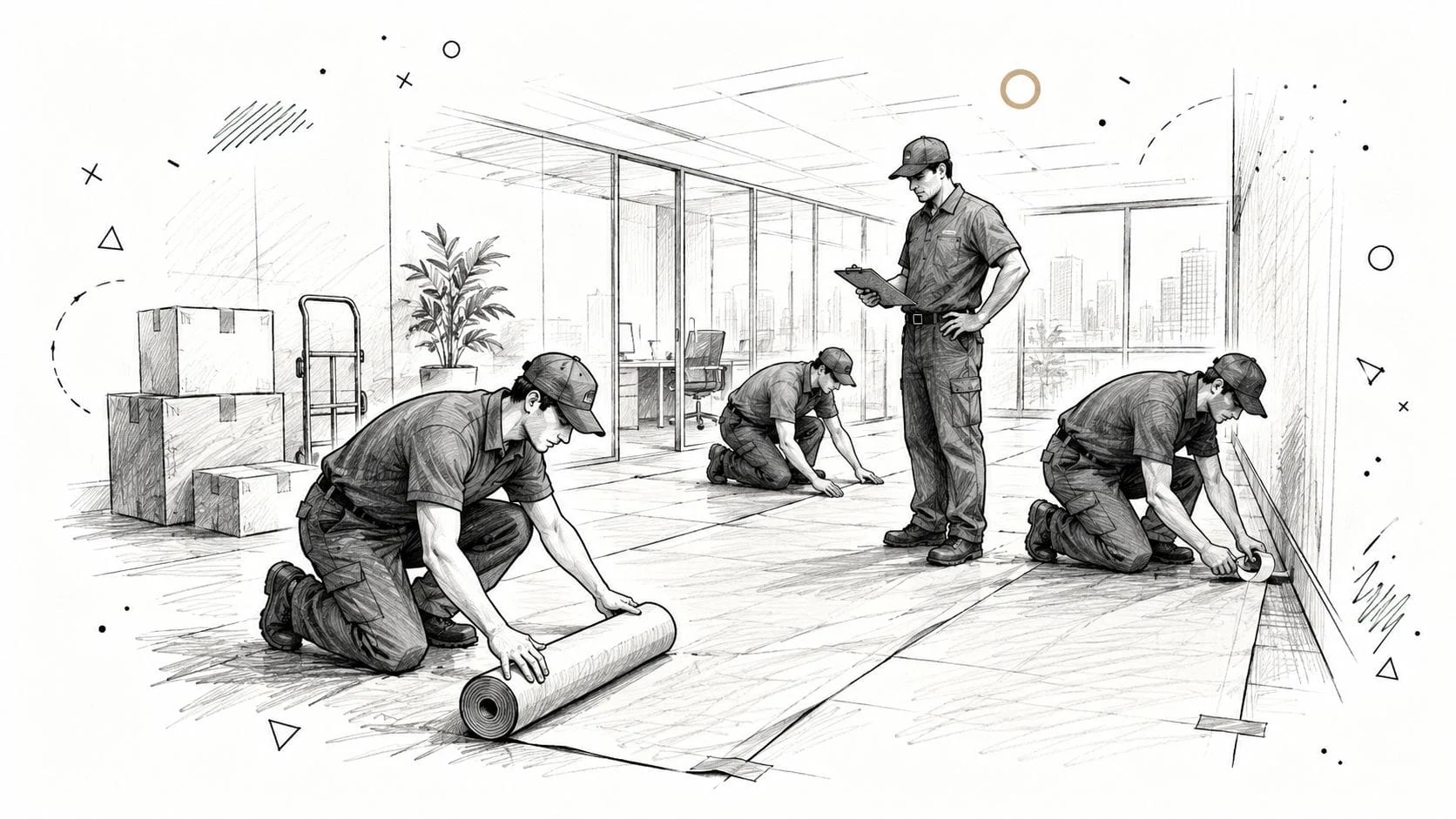
The first visible sign of a proper setup is usually protection. Floors in high-traffic routes are covered, door frames are checked, and any shared areas are treated carefully because those are the spaces most likely to be marked during a commercial move.
Workers installing flooring in modern office space

How the old office is cleared

The crew should work according to the agreed order rather than clearing rooms randomly. Crates labelled for a particular team stay together. Furniture that needs dismantling is handled before access routes become blocked. Final desk items are usually loaded later, so key staff can remain productive for as long as possible.

Before departure, there should be a walkthrough of the old premises. That final check is where forgotten chargers, cupboard contents, and small comms items are usually spotted.

What happens at the new office

At the destination, placement matters more than speed on its own. It’s much better to put each item in the right room first time than to create a second internal move later because desks, crates, or pedestals were dropped wherever space was available.

The unload stage usually works best when:

  • Rooms are clearly named: The destination plan matches the labels on furniture and crates.
  • One client contact signs off on placement queries: Staff don’t give conflicting instructions.
  • Priority items are identified early: Reception desks, senior workstations, and essential printers are placed first.


For businesses checking policy wording before the move, this explanation of goods in transit insurance is worth reviewing.

Post-relocation checks that shouldn't be skipped

Once the vehicle is empty, the job still needs a short review. The client or office manager should confirm that key items are present, placed correctly, and visibly undamaged. IT teams can then check the equipment sequence they prepared before the move.

The best post-relocation checks are simple:

  • Confirm that all rooms received the right crates and furniture.
  • Check dismantled items have their fittings and can be reassembled fully.
  • Verify priority equipment is where the team expects it to be.
  • Remove leftover packing debris and redundant labels so the office is usable immediately.

How to create a video walkthrough for a faster quote

A video walkthrough is often the quickest way to get a useful office move quote without waiting for a site visit. It doesn't need polished editing or a scripted presentation. It only needs to show the removal team the full scope of the move clearly enough to price it properly.

For office removals in London, a good video is often more useful than a long written description because it shows access, volume, and awkward items in one pass.
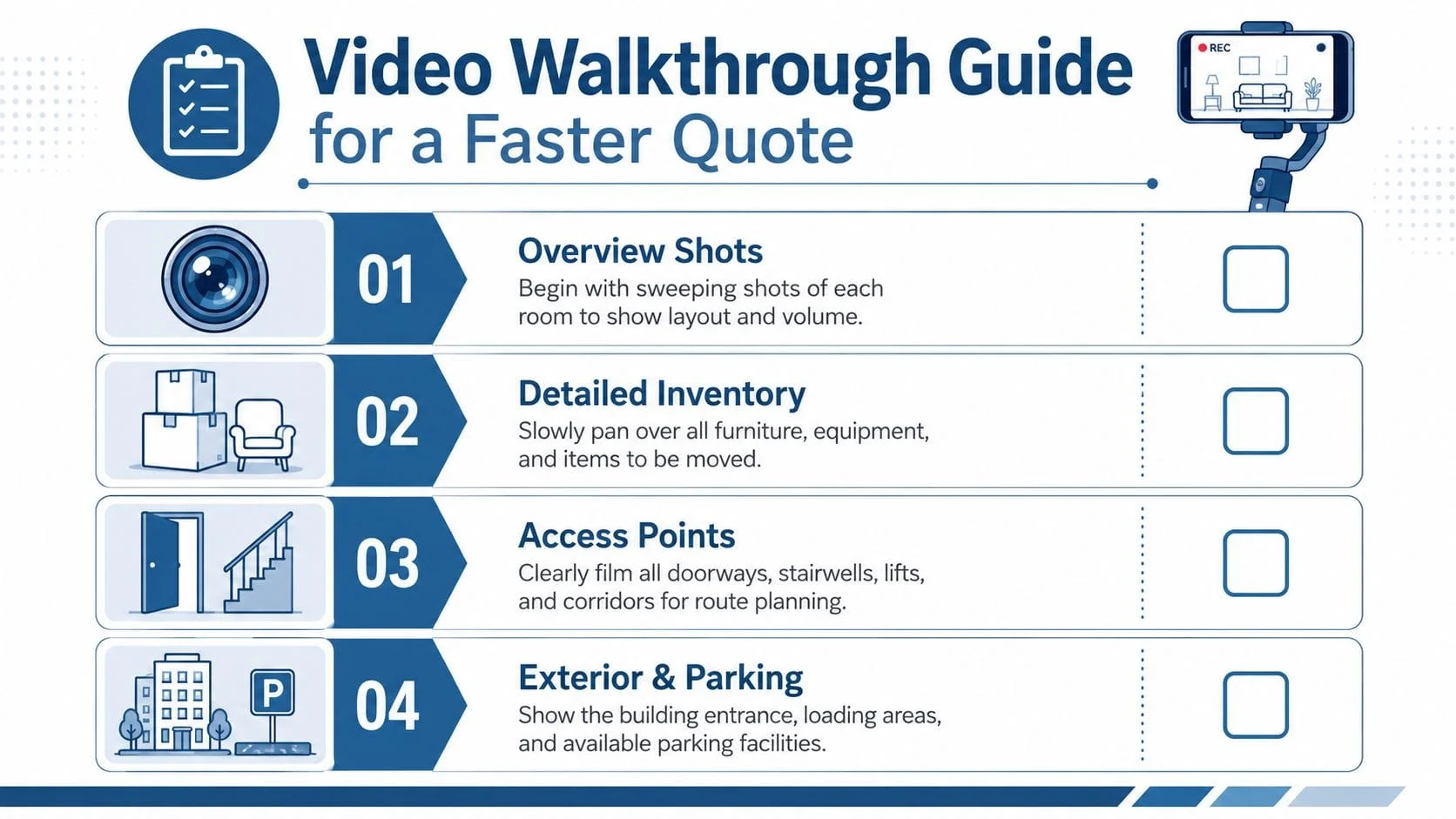
Video walkthrough guide checklist for faster quote

What to film

Use a mobile and keep the pace slow. The camera should pause long enough for cupboards, desks, and access routes to be seen properly.

A useful sequence is:

  • Start outside the building: Show the entrance, nearby road layout, and any likely loading position.
  • Film the route in: Record stairs, lifts, corridors, and any tight turns between the entrance and the office.
  • Walk through each room: Pan across desks, chairs, storage, kitchen areas, and meeting rooms.
  • Open cupboards and store rooms: Closed doors often hide a large part of the move volume.
  • Show unusual items properly: Large printers, server racks, glass tables, or heavy cabinets need a longer shot.
  • Mention the destination postcode and timing: That helps the quote reflect real planning needs.

What makes the video more useful

A spoken commentary helps if there are special requirements, such as weekend access only, furniture to be disposed of separately, or a destination building with restricted lift hours. The camera doesn't need to be steady like a marketing video. It only needs to be readable.

Slow, clear filming is better than fast filming with lots of commentary.

Frequently asked questions

Start with a survey to confirm volume, access, and any specialist handling needed, then turn that into a written schedule covering responsibilities, loading order, and delivery placement. Confirm parking suspensions or loading bay bookings early, and treat IT and server relocation as a separate, clearly scoped part of the plan.

For most London office moves, four to six weeks from survey to move day gives enough time to book parking suspensions, confirm goods lift access, and pack in stages. Larger relocations into managed buildings, or moves involving server rooms, often need longer lead times for permits and specialist handling.

Cost depends on volume, access, floor levels, dismantling, and whether packing materials or server handling are included. A fixed-price quote, built from a survey or video walkthrough, is the only reliable way to get an accurate figure. Hourly charging can work for very small, self-packed moves, but carries more risk in London traffic and access conditions.

In most cases, yes. Parking suspensions and loading bay permits vary by borough and street, and Westminster, Camden, and Kensington tend to have tighter controls than outer boroughs such as Hillingdon. The removal company should confirm what’s needed for your specific address and include the cost in the quote.

For many London offices, yes. A Friday evening to weekend move lets staff finish the week in the old office and gives IT and facilities teams time to test connections before Monday. Smaller offices in serviced buildings, or those with live client work, sometimes suit a phased or evening move instead.

If an office relocation in London is coming up and a clear plan would help, Best London Removals Ltd can review a video walkthrough or arrange a survey, then provide a written itemised quote for the move scope, access requirements, and scheduling. Details of the office removals London service are on the main service page.

Table of Contents