

A London controlled parking zone (CPZ) is a borough-defined area where on-street parking is regulated by permit during posted hours, but the loading window a removal van can use is governed by the most restrictive sign at the kerbside, not by the zone label itself. Centre for London’s research shows there are more than three million licensed vehicles in London, and the average car is parked for at least 95% of the time, which is a large part of why kerb space is managed so tightly across the capital, and inner London boroughs control a much larger share of their kerb space than outer London boroughs do.
That’s where moving day goes wrong. A van pulls up outside a terraced house, the driver sees a yellow line, assumes a short stop will do, and a penalty charge notice (PCN) lands later because the street sat inside a CPZ that should have been checked before the lorry was booked. The zone is only the starting point. The real question is whether the kerbside at that exact address allows a legal loading window for the size of the vehicle, the day of the week and the time the crew needs.
What a controlled parking zone in London means
A CPZ is easy to misread because it looks like a general parking area, but it’s a legal control system. The entry sign sets the controlled hours for the zone, and those hours tell drivers when waiting is restricted inside that area, while the road markings and bays inside the zone still have their own rules. Transport for London’s parking and loading guidance confirms that CPZs apply to borough roads, and drivers should check the zone times carefully before parking or stopping to load.
A removal van that arrives outside those hours can still be caught out, even if the street looks quiet. The zone is built around resident and business parking demand, not around the convenience of a short commercial stop.
Practical rule: the zone label tells the driver that controls exist, but the entry sign and the nearest bay sign tell the driver what’s legal at that kerb.
For movers, two checks matter most. First, confirm whether the origin and destination sit inside a CPZ at all. Second, work out whether the van can legally wait long enough to load or unload without relying on a guess about “a few minutes.” Our moving and storage services cover this kind of planning, where kerb access, timing and temporary holding all need to line up together.
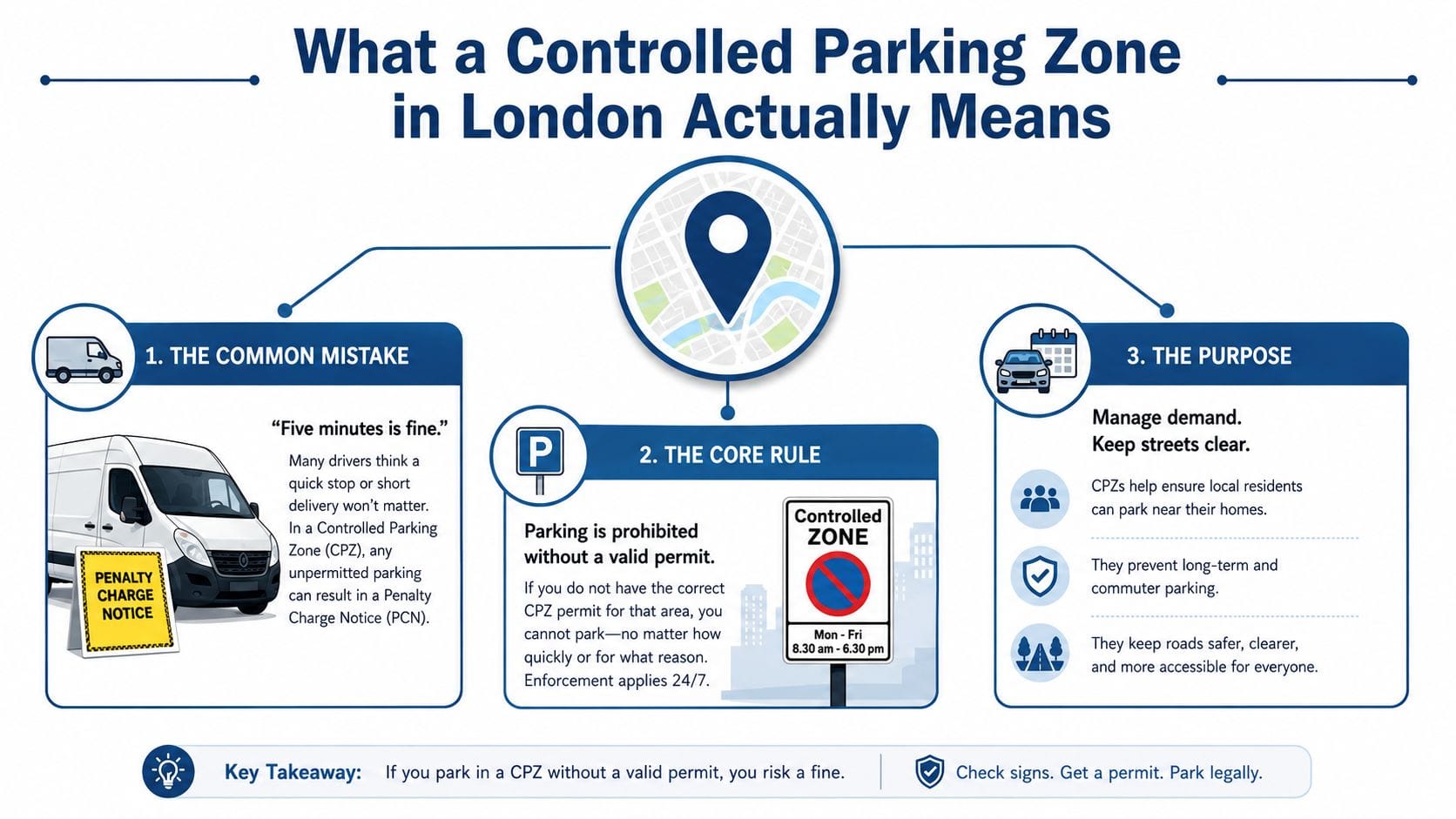
How CPZ rules and permits are built
Single yellow lines and double yellow lines are the first clue, but they don’t tell the whole story. A single yellow line usually means waiting is restricted only during controlled hours, while a double yellow line is controlled at all times. The zone entry sign then overlays the wider area with the specific hours that apply. Lambeth’s controlled parking zones guidance confirms that single yellow line restrictions in the borough generally run 8.30am to 6.00pm, Monday to Saturday, unless a local time plate says otherwise, and that double yellow lines are controlled 24 hours a day.
The sign combination that matters
A borough can use zone-wide controls, then narrow them again with a bay plate at the exact loading point. That’s why a van can be legal on one side of the road and not the other, or legal at 7am but not at 9am. The Department for Transport’s Traffic Signs Manual describes two types of CPZ: type (a), which uses road markings plus zone entry signs and applies to all vehicles, and type (b), which applies only to commercial vehicles, usually overnight, and doesn’t use road markings.
The City of London shows how different one borough can be from another. Its controlled hours run Monday to Friday 7am to 7pm and Saturday 7am to 11am, and dropped kerbs and raised carriageways can be enforced there without additional signage.
If the bay plate is stricter than the zone sign, the bay plate wins at that location.
Permits are not optional inside permit bays
Waltham Forest’s guidance explains that CPZs prioritise residents, businesses and visitors during certain days and hours, and a valid permit must be displayed or a penalty charge notice can follow.
That’s why permit hunting and loading planning are different tasks. A resident permit might solve day-to-day parking for the occupier, but it doesn’t automatically give a removal van a legal loading stop. For a move in Twickenham or elsewhere in outer London, the question is still whether the street allows the van to wait at the exact time needed, not whether the household has a parking badge. Our guide to removals in Twickenham covers how street layout and local restrictions affect that kind of move.
How to check if an address is in a CPZ
The safest check starts with the borough’s own parking page, not a guess from the estate agent or landlord. Most councils publish CPZ maps, zone names and controlled hours by postcode or street, which is the fastest way to establish whether an address sits inside a controlled area before the booking is confirmed. For a moving crew, the map matters because a nearby street can sit in a different zone with different hours.
After that, the entry sign has to be checked in person. A map can confirm the zone boundary, but it can’t show the exact bay plate, the dropped kerb, the corner loading bay, or the shared use bay that changes the rule at the kerb. That’s especially important where a zone boundary runs across the same side road or where the street layout is irregular. The practical habit we use is simple: never trust the address alone.
The kerbside checks that actually prevent problems
- Check the borough map first. Confirm the address, the zone name and the controlled hours on the council page before the van is booked.
- Read the sign at the exact loading point. A bay plate can be stricter than the zone entry sign, so the spot itself matters more than the street name.
- Look for dropped kerbs. These can be enforceable without extra signage, so a clear-looking space may still be off limits.
- Watch for shared use bays. Permit holders, pay-and-display and loading can coexist, which means the van may need to use a very specific part of the bay.
The address is only the starting point. The kerbside tells the truth.
For a London move, this step should happen before the removals date is fixed, and at both ends of the move. Our page on CPZ rules in Ealing is a useful borough-specific reference, since the same postcode can hide very different loading conditions from one street to the next.
CPZ permit types and who qualifies
Permit rules vary by borough, but the main categories are familiar once separated cleanly. The key point is that a permit helps with parking access for the person who qualifies for it, but it doesn’t change the legal loading window for a van moving furniture or office equipment.
Resident permits usually apply to people who live at the address and can show proof of residence, plus vehicle details that fit the borough’s criteria. They matter most for households that need regular parking access, but they rarely solve moving day on their own, because the removal vehicle isn’t the permit holder’s car.
Visitor permits and vouchers are useful when family, friends or helpers are arriving to support the move. They can be the difference between a helper parking legally and circling the block while the lifting team has already started.
Business permits are aimed at traders, offices and commercial occupiers working inside the zone. They matter for small businesses, but the permit should still be checked against the borough’s vehicle class rules and evidence requirements before assuming it will cover an office relocation vehicle.
Temporary or seasonal permits appear in some boroughs for short-term needs, but they aren’t universal. Where they exist, they can help during a move-in period or while waiting for a permanent permit decision.
The key operational issue is availability. Some boroughs cap permits or place applicants on waiting lists, and second vehicles can face higher charges or exclusions. That means a landlord, tenant or office manager should never assume a permit will be available merely because the postcode sits inside a CPZ.
Parking suspensions and loading bay bookings for moves
A parking suspension and a loading bay booking solve different problems, and mixing them up causes avoidable trouble on moving day. A suspension reserves kerb space outside a property for a specific date and time, while a loading bay booking uses an existing legal bay for short-term loading. The council wants different evidence for each, and the sign on site has to match the booking, not the hope that the crew can make it work once they arrive.
For a suspension, the location has to suit the actual vehicle and the street layout. A booked space that’s too short, blocked by street furniture or too close to a junction can be refused, because councils can reject unsafe or impractical placements. The paperwork usually includes the address, date, time, vehicle details and the reason for the suspension, and the council may expect the suspension notice to be visible on site on the day.
Loading bay bookings are tighter still, because they rely on a bay that already exists and is already regulated. That can suit a flat move on a busy street better than waiting on yellow lines, but only if the bay’s hours match the move window. A permit and a suspension are separate products, so paying for one doesn’t cover the other.
The money isn’t the whole question. The van has to fit, the street has to allow it, and the booking has to cover the actual loading time.
In practice, the checks that prevent PCNs are simple but easy to miss: confirm the exact kerbside sign, the bay type, the hours, the vehicle class and whether the booking sits inside the move window needed. Borough process matters as much as the removals plan for longer access constraints, which is why we treat parking and building access as one job rather than separate admin. That’s the focus of our guide on parking suspensions when moving house in London, and our parking suspension and dispensation service covers how we arrange this as part of a booking.
For moves involving more than one address, the loading window often decides everything. A van can arrive legally and still be stuck if the bay is too short, the timing is wrong, or the suspension doesn’t cover the frontage where the lift is happening. The same applies whether the job is a house move, a partial office relocation or a tight student load-out in a busy borough.
Whether CPZs really solve London’s parking pressure
A CPZ rarely solves parking pressure in the tidy way borough consultations suggest. It usually moves the pressure around. Inner London controls most of its kerbside space, while outer London is controlled far less tightly, so the zone label itself tells you less than the sign at the exact stretch of road where the van needs to stop.
That’s the policy trade-off boroughs live with. CPZs are introduced or extended because of resident demand, regeneration, traffic control and air quality concerns, but one street’s protection often means another street takes the overflow. For removals crews, that means more permit-only bays, more short-stay bays and more places where an unscheduled stop can turn into a PCN before the first item is out.
The practical lesson is simple. The risk on moving day usually isn’t the controlled parking zone as a whole; it’s the most restrictive sign at the kerbside being used. A van can be perfectly legal in the postcode and still be in trouble if the bay type, hours or loading terms don’t match the work being done. That’s why a suspension needs to be checked against the frontage and the actual loading window, not just the address on the booking.
CPZs are best understood as a managed scarcity tool. Once permit limits, waiting lists and tighter bay controls are in play, the question changes from whether a van can stop somewhere nearby to whether the street allows the load to happen at the exact time and place required. Borough consultations often focus on resident parking balance; movers need the narrower answer: which sign governs the kerb, and how long the van can stay there without triggering enforcement.
Three London move scenarios and how the rules play out
A family leaving a terraced house in W3 on a Saturday morning might see a single yellow line and think the loading can stretch past breakfast. If the controlled window ends while the crew is still carrying, that stop becomes risky fast, so the first checks should have been the borough map, the zone entry sign and the nearest bay plate. For that kind of street, the answer isn’t the postcode alone; it’s the exact window at the kerb.
A couple moving out of a mansion block in SE1 faces a different problem. The shared service road may have building rules, a zone sign and a bay-specific plate all pointing in different directions, so the managing agent and the borough parking team both need checking before the van is booked. For a property like that, a move plan is only as good as the strictest sign and the lift slot.
A small agency relocating two floors of staff in W1 has another layer again. The loading bay booking has to match the weekday controlled hours, the freight lift booking and the vehicle size, or the handover stalls at the pavement.
A Practical Pre-Move Checklist and Common Pitfalls
Before any moving date is confirmed, the first checks are simple. Confirm the CPZ status of both addresses, read the most restrictive sign at each loading point, book any suspension or loading bay slot early, sort visitor permits if family will help, and brief the crew on the exact kerbside they can use. If the building has a service road or freight lift, that needs to be tied into the same booking, not left for the morning of the move.
The common errors are predictable. A five-minute stop on a single yellow line inside a controlled window isn’t a safe assumption. Double yellow lines and dropped kerbs can be enforced without extra signage, and a paid permit doesn’t cover suspension charges.
Ask the borough parking team three questions before booking the van: what are the controlled hours, is the exact loading point signed differently, and does the booking need a suspension or a loading bay slot?
A move that starts with those answers is far less likely to end with a PCN, a late van or a crew waiting outside a locked front door.
We plan London moves around access as well as carrying, which matters whenever a controlled parking zone limits where the van can wait. For help with house moves, flat moves, office relocations and parking-sensitive bookings across London, contact Best London Removals Ltd to arrange a move that fits the street, the building and the loading window.
This guide is intended as general information about parking regulations. It is not legal advice. Controlled parking zone rules and hours can change, so always confirm current signage with the relevant borough before booking a move.