

A piano removal often starts with a simple search for “piano removals near me.” The van is booked, the new flat is ready, and the instrument appears to need only a short trip across London. Then someone measures the second-floor landing and finds that the upright won’t turn past the bannister, or the building manager confirms that the shared lift can’t take its weight.
That moment changes the job. A piano isn’t ordinary furniture that can be pushed, tilted and squeezed through later. The route, crew, equipment, floor protection and legal loading space have to be assessed before a move date is confirmed. For London homeowners, renters and musicians, the most useful question isn’t who is nearby. It’s whether the mover has planned the entire route from the piano’s position to the vehicle, then from the vehicle to its destination.
Why a piano move in London is not a normal removal job
A customer with an upright piano in a Georgian terrace may have a clear room and a wide front door, but the staircase can still stop the move. The instrument may pass the first flight, then behave like a heavy pendulum at a dog-leg landing, with the top edge swinging towards a wall while the base moves in the opposite direction. Two friends and a hired van can handle many household items, but a piano can expose the limits of that arrangement quickly.
Weight is concentrated on a small footprint. Upright pianos typically weigh somewhere between 150 kg and 270 kg, while full-size grands typically run from around 350 kg up to 500 kg or more, ranges consistent with manufacturer specifications. A dolly, board or skid must distribute that weight properly across floors and thresholds.
The shape is awkward too. A piano has a high centre of gravity, delicate external panels and vulnerable internal components. A jolt that leaves a wardrobe with a mark can affect the action, bridge, soundboard or castors of a piano. The instrument can also react to temperature changes during transport, which is why customers should tell the mover whether it has been tuned recently.
London buildings amplify those constraints. Victorian houses often have narrow hallways and sharp stair turns. Mansion blocks can have small shared lifts, decorative newel posts and communal entrances that can’t be blocked casually. Converted warehouses may offer large rooms but awkward loading routes, basement access or lifts with restrictive dimensions.
Practical rule: muscle doesn’t solve a route that hasn’t been measured. Planning determines whether the piano stays supported and whether the building remains protected.
Crew size also needs proper thought. A two-person team may be suitable for a straightforward ground-floor instrument, but a stair carry changes the handling method and can require additional movers. Customers considering a broader household move can compare the route and role allocation with the guidance on a two-man moving team, while piano work needs a more specialised assessment.
Upright and grand pianos and how each is carried
The carrying method depends heavily on the piano’s design. An upright normally remains vertical, while a grand is prepared, partially dismantled and supported on its side. That difference affects doorway clearance, lifting points, crew briefing and the equipment required.
Upright piano handling
The crew protects the case, keyboard and pedals before tipping the upright carefully onto its rear legs. A piano board or skid is positioned underneath, allowing the instrument to roll on suitable skids or a piano dolly. Keeping the load supported at the stronger rear castor area helps the crew control movement across level surfaces.
Stairs are different. The dolly may no longer remain under the piano, so carrying straps and a controlled team lift become necessary. The crew keeps the upright vertical while managing the balance through landings and turns. Doorway width alone isn’t enough, because the team also needs room to stand, rotate and maintain control.
Grand piano preparation
A grand or baby grand needs more preparation. The lid and music desk are removed and protected, the fallboard is secured, and the keys are covered against movement. The legs and pedal lyre are unscrewed, with each component wrapped and labelled so reassembly is straightforward.
The piano body is then placed on its side on a heavy-duty piano board or skid. That board supports the belly of the instrument and creates a controlled surface for moving it through corridors, lifts and loading areas. The team must confirm that the body, once positioned on its side, can clear every doorway and turn.
| Aspect | Upright piano | Grand piano |
|---|---|---|
| Main position | Remains vertical during the carry | Usually rests on its side on a specialist board |
| Key access concern | Stair width, landings and turning points | Doorway clearance for the body on its side |
| Preparation | Case, keyboard and pedals protected | Lid, legs, pedal lyre and music desk removed and wrapped |
| Support method | Piano dolly, skids and carrying straps | Heavy-duty board, skids and controlled lifting points |
| Route planning | Focuses on keeping height and balance stable | Focuses on body length, width and side-on clearance |
Walls, bannisters and door frames need protection because a piano can make contact even when the route appears just wide enough. A suitable door frame protection method helps reduce damage during tight manoeuvres, but it can’t compensate for a route that was never surveyed.
Why specialist handling and proper equipment matter
Generic furniture equipment is designed for loads that are easier to balance. A piano needs a method that controls a tall, uneven object whose centre of gravity can shift as it crosses thresholds or changes angle on stairs.
An upright’s weight sits high and forward, which makes a basic sack trolley risky on a curved Victorian staircase. The trolley can tip away from the operator, catch a step or place sudden force on the piano’s case. A piano board, locking dolly, padded carrying straps and suitable skids spread the work between the crew and keep the instrument supported.
Purpose-built boards give the piano a stable base during tilting, loading and side-on movement. Locking dollies prevent unwanted rolling while the team positions straps or negotiates a threshold. Ramps and skates can help where the route allows them, while padding protects both the piano and the property.
The Health and Safety Executive’s guidance on manual handling sets out indicative filter weights of 25 kg for men and 16 kg for women when a load is held close to the body at waist height, with lower figures where the load is held further away or above shoulder height. Those figures aren’t legal limits, but they’re a useful illustration of why a piano shouldn’t be treated as a solo carry or an improvised two-person lift.
The instrument matters after delivery
Damage isn’t limited to visible scratches. A hard impact can affect the soundboard, bridge, action alignment or casters. Even when the piano reaches the destination without a cracked panel, the owner may notice changes in touch or tuning.
Temperature changes during transport can affect tuning, regardless of how carefully the piano is handled. That doesn’t mean every move causes a tuning problem, but customers should plan for the possibility and avoid judging the mover solely by whether the instrument sounds identical immediately after delivery.
A professional method protects three things at once: the piano, the building and the people carrying it. The equipment isn’t an optional upgrade. It reflects the awkward load and the route being attempted.
What a professional piano survey actually covers
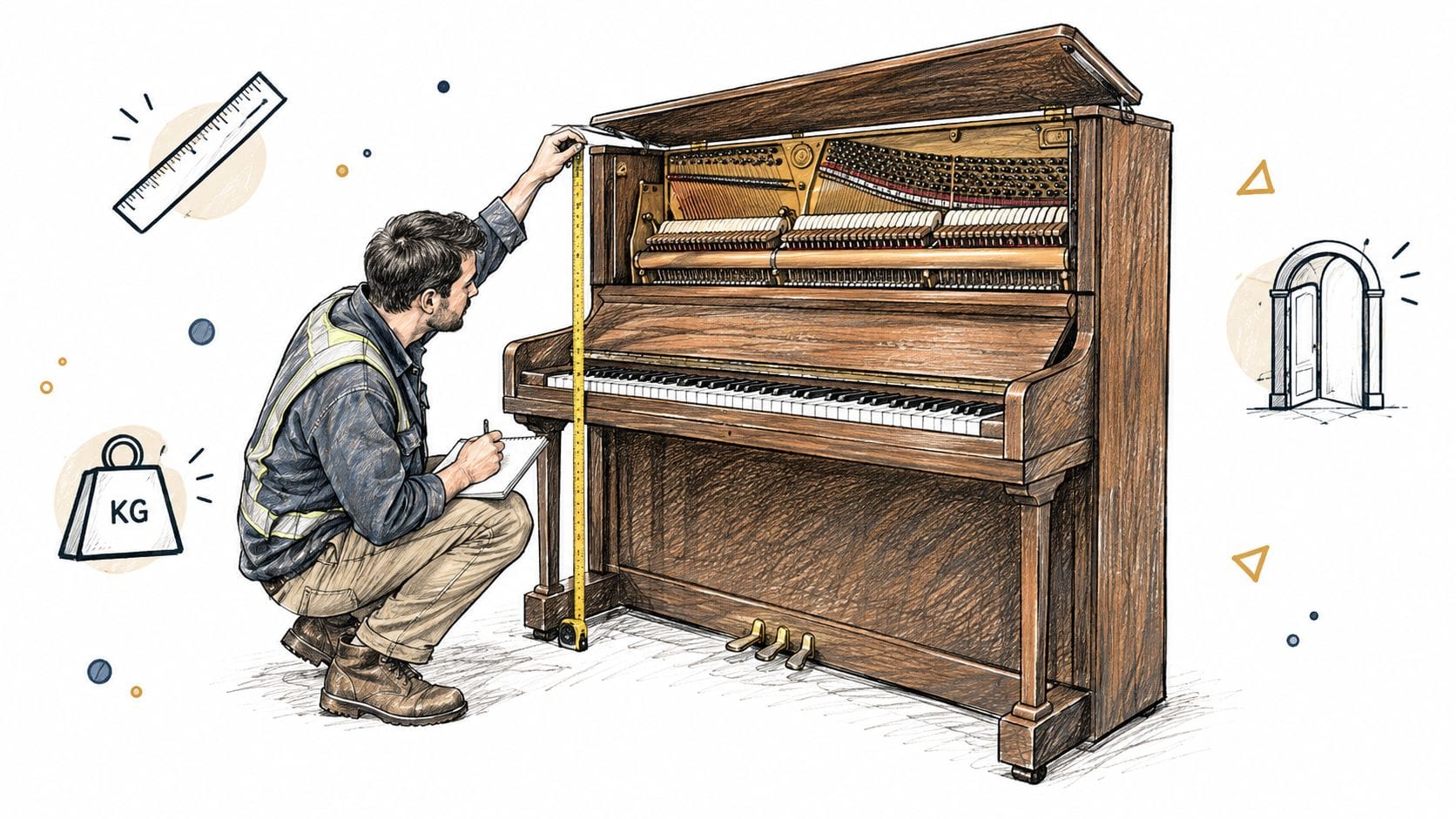
A piano survey starts with the instrument, not the postcode. The surveyor measures the piano’s height, width and depth, considers its weight class and checks the lid configuration if it’s a grand.
From the piano to the staircase
The surveyor then follows the actual route rather than relying on a general description. Every doorway, corridor, staircase turning point and landing is measured between the piano’s current position and the vehicle. A narrow section may be photographed, especially where a bannister, radiator, alcove or newel post affects the turning space.
The assessment includes stair pitch, handrail position, removable sections and floor surfaces. Rugs, loose flooring, polished parquet and vulnerable thresholds are noted because protection needs to be planned before the piano is moved. A route that works for people walking through may not work for a piano board and a crew carrying straps.
Goods lifts need verification too. The survey checks the lift’s internal dimensions, door opening and stated weight limit. Older London buildings often have lifts that can carry boxes and lighter furniture but cannot take a piano. The survey also considers whether building management requires a booking, protective lining or a restricted moving window.
From the entrance to the kerb
Outside, the surveyor looks for the safest vehicle position. The removal vehicle needs to get close enough to reduce the unsupported carrying distance, while its tail lift must clear lamp posts, low branches and other street furniture. The survey records loading restrictions, resident bays, controlled parking zones and whether a parking suspension is needed.
This information determines the crew size, vehicle choice, protective materials and rigging plan. It also allows the quotation to reflect the job instead of an optimistic assumption based on piano type alone. A description-only quote can’t reliably identify a staircase turn or an unsuitable lift, which is why an in-person survey is the more dependable starting point.
A real London piano move from a fourth-floor Kensington flat
A recent move involved a 320 kg upright piano on the fourth floor of a Kensington flat. The building had a small shared lift, but it was intended for boxes and lighter items rather than the piano or larger furniture. At the survey, Ivelin measured the instrument and each staircase turning point to confirm that the carry route was achievable before the booking was accepted.
The team planned around four flights of stairs and a restricted parking position near Cromwell Road. The piano was padded with protective blankets and wrapped in stretch film before the case was secured with carrying straps fitted at its balance points. The shared lift wasn’t used for the piano, so the five-man crew, working across two days with two 3.5-tonne MaxiMover vans, could focus on maintaining a controlled vertical carry through the stairwell.
When the route is tighter than expected
On the day, the staircase proved fractionally tighter at one turn than the survey measurements suggested. Instead of forcing the instrument through, the crew adjusted the handling position and used a second piano board swap to keep the case clear of the newel post. That decision added handling work, but it protected the piano and the building.
The piano was delivered without incident to a storage unit at Shurgard in South Ruislip. The useful lesson isn’t that every Kensington piano move needs the same arrangement; it’s that a survey should create a workable contingency for the awkward point in the route. Crew numbers and vehicles are selected after the measurements, not chosen because the piano happens to be an upright. The full case study is set out on our Kensington to Ruislip piano and storage move page.
Parking suspensions and London access constraints
A piano can be carried correctly inside the property and still face a delay at the kerb. In London, the distance between the vehicle and the entrance directly affects how long the load remains unsupported and how many obstacles the crew must cross.
A parking suspension sets aside a specific on-street bay for a removal vehicle. A pavement or highway licence is a different permission and may be needed where loading requires use beyond an ordinary parking bay.
Borough rules change the plan
Kensington and Chelsea, Westminster and Islington can be particularly difficult for piano work because resident-only bays, controlled parking zones and short loading windows may prevent a large vehicle stopping close to the entrance. Camden can present similar access issues, especially around narrow streets and busy residential blocks.
Our supplied operational practice is to arrange parking suspension applications typically three weeks before the move date, giving the team more room to deal with borough processing and booking constraints.
| Borough | Suspension planning | Common restriction |
|---|---|---|
| Kensington and Chelsea | Early application is sensible | Resident bays, controlled parking zones and limited loading space |
| Westminster | Requires careful timing | Busy kerbs, loading windows and central London restrictions |
| Islington | Route and vehicle position need checking | Controlled parking zones and narrow residential streets |
| Camden | Building and street rules should be confirmed | Restricted bays, narrow roads and limited stopping opportunities |
Bus lanes, red routes, double yellow lines and resident bays can all prevent the vehicle from taking the position the crew needs. Where an exact-date suspension isn’t possible, the survey may identify a nearby loading bay or another lawful alternative, but the route then needs reassessing.
Our guide to controlled parking zones in London helps customers understand why the booking date and loading time can be governed by the street rather than the piano alone. A correct suspension should be identified before the quote is accepted, not treated as a problem for moving day.
Questions to ask before booking a piano removal
A piano removal quote should answer more than “how much?” The customer needs to know whether the mover has understood the instrument, the building and the legal loading arrangements.
Insurance and liability
Ask whether the company carries goods-in-transit insurance and whether the piano’s declared value matches its realistic replacement cost. Standard household-removals cover may have a cap that doesn’t reflect a valuable instrument, particularly a well-maintained grand or an older piano with significant replacement difficulty.
Public liability cover matters inside the property too. A stair carry can affect bannisters, plaster, flooring, shared corridors and lift interiors, so the policy should be suitable for the actual work rather than mentioned as a general assurance. Customers can review how goods-in-transit insurance fits into a removal booking before paying a deposit.
Questions that expose the quality of the plan
Survey method: who carries out the survey, and are the piano and every doorway, corridor and turning point measured in person?
Crew briefing: how will the team receive the route notes, photographs and instructions before arrival?
Equipment: will the quote identify the piano board, skids, straps, stair walker, ramps or skates required?
Property protection: what is used on bannisters, door frames, corners, floors and lift interiors?
Parking: does the company identify and support the correct suspension, loading bay or licence?
Contingency: what happens if the lift fails, a staircase is tighter than expected, or rain prevents safe loading?
Documentation: can the customer receive the surveyor’s name, booking terms and insurance schedule?
A phone-only quote may sound convenient, but it can’t confirm a hidden landing, a low lift ceiling or an entrance that becomes inaccessible when a vehicle is parked. Customers should avoid moving the piano themselves before the survey and should clear rugs, loose flooring and obstacles from the route once the method has been agreed.
How we handle piano moves across London
Our piano workflow begins with an in-person survey that measures the instrument, records the route, photographs access points, checks goods-lift capacity and assesses where the vehicle can lawfully and safely position outside.
The written quotation then reflects the findings. It identifies the expected crew size, vehicle type, protection materials and any parking suspension support, rather than treating an upright or baby grand as a standard item. We’re a member of the National Guild of Removers & Storers, which carries compulsory membership of the Removals Industry Ombudsman Scheme, and we provide goods-in-transit and public liability cover on every job.
The moving-day method
The piano is wrapped and secured to a suitable board before the dedicated team begins the carry. Depending on access, the crew may use stair walkers, ramps, skates, skids and piano dollies, with the equipment selected from the survey rather than added after an obstacle appears.
We cover central, north, south, east and west London, including boroughs where parking and shared-building access need advance planning. Weekday, weekend and bank holiday scheduling can be considered where building rules restrict the available moving window.
The practical next step is to request a survey before accepting a quote. A measured route gives the customer a clearer basis for comparing movers, confirming insurance and understanding why the crew and vehicle have been selected.