


A kitchen refit in a London flat can become unmanageable before the first cupboard comes down. The builder needs clear floors; the hallway is filled with boxed crockery; the sofa blocks the only route to the front door; and the planned start date moves while storage arrangements remain unfinished. By the time demolition begins, belongings may have been shifted several times, exposed to dust and moisture, or loaded into a unit that was never suitable for them.
Storage during renovation works best when it’s treated as part of the building program, not as an afterthought. The right decision depends on the property, access, the volume to be removed, the need for retrieval during the works, and whether the project lasts weeks or several months. A Victorian terrace in Islington, a basement flat in Wandsworth, and a modern development near Wembley each present distinct loading and storage challenges.
Why renovation storage needs proper planning
A Victorian terrace in Islington demonstrates how quickly a small delay can become a removal problem. The builder’s start date slips by three weeks, but the skip arrives on the original date. Furniture is still in the dining room, the contractor needs the hallway clear, and the homeowner has to find emergency storage at short notice. The result is rarely limited to inconvenience. Collection routes become congested, belongings are moved repeatedly, and the renovation team loses usable working space.
London properties add practical complications that generic storage advice often misses. Period conversions can have narrow stairwells and tight turns, while basement flats may offer limited loading access. A large wardrobe that fits comfortably inside a room might not pass through the stairwell or around a landing. Parking also needs early attention. London councils commonly require two to three weeks’ notice for a parking suspension, and the precise process differs between boroughs, so a late booking can leave a removal vehicle unable to stop outside the property.
Clear the room before the tools arrive
Most builders expect rooms to be empty before demolition, flooring, plastering, or electrical work begins. Leaving furniture in place doesn’t protect it. Dust travels through doorways and ventilation routes, while tradespeople need safe, unobstructed paths for materials and waste.
The UK self-storage sector continues to grow in response to demand from households in exactly this situation. The most recent SSA UK and Cushman and Wakefield Annual Industry Report records total UK self-storage space at 67.5 million square feet and annual industry turnover at £1.3 billion, with home renovation cited as one of the most common reasons for using storage.
Practical rule: the collection date should follow the confirmed construction programme, not the first estimated start date.
Match storage to the project
A six-week kitchen refit favors a compact self-storage unit if the household needs regular access to appliances or crockery. A full-house strip-out lasting six months usually favors a planned decant, with belongings collected once and returned after the property is ready.
Climate and building conditions also matter. Sensitive furniture, artwork, instruments and electronics may need a climate-controlled facility, particularly when the storage period extends through changing seasons. The decision should be based on what the goods need, not only on the nearest available unit.
Surveying and sorting belongings before the work starts
The survey should begin room by room, with each item assigned to a clear destination. A useful method is to separate belongings into daily essentials, off-site storage, and disposal or donation. This prevents the common mistake of sending every possession into storage, then paying to keep items that no longer belong in the renovated home.
Create three working zones
Daily essentials can be relabeled in a sealed, dust-controlled area approved by the contractor. In a two-bed Victorian flat, the box room might hold a limited number of labelled essentials, provided it stays outside the work route and isn’t affected by damp. A terraced house might use the loft as a temporary staging zone, but only if it is dry, accessible, and structurally capable of supporting the load.
Valuables and fragile goods deserve a separate decision. High-value artwork, delicate wood, instruments and sensitive electronics may need a more controlled environment than ordinary household boxes. Bulk furniture, books, kitchenware, clothing, and general cartons can usually be assessed for standard container storage once they’ve been cleaned, dismantled where appropriate, and labeled.
The third category is the one most often ignored. Broken furniture, unwanted children’s items, duplicate kitchenware, and low-value goods should be donated, recycled, or disposed of before collection. Reducing volume can reduce storage requirements and make the move easier through narrow London access points.
Survey the route, not just the rooms
A professional survey should measure large furniture against door frames, stairwell turns, lift dimensions, corridors, and the vehicle loading position. A marble tabletop, grandfather clock, or oversized mirror may need specialist protection or crating rather than ordinary wrapping.
The survey should record:
Large dimensions. Measure wardrobes, sofas, beds, tables, and appliances, including dismantled and assembled dimensions.
Access restrictions. Note stairs, turns, goods lifts, controlled entrances, concierge procedures, and basement loading limitations.
Special handling. Flag clocks, marble, glass, artwork, antiques, and unusually heavy pieces before the quotation.
Final decisions. Mark every item as staying, storing, donating, recycling, or requiring separate specialist treatment.
A proper inventory doesn’t need to describe every small object inside every carton. Large items must be listed clearly, while grouped boxes can be recorded by room and category.

The survey date should be tied to the builder’s actual mobilisation date. If demolition moves, collection may need to move with it. A removal arranged for the originally quoted start date can create unnecessary handling if the property isn’t ready, while a late collection can delay trades already booked to begin.
Choosing between self-storage and a removals company’s storage
Self-storage and removals company storage solve different operational problems. A self-storage unit offers direct access, but the customer must arrange transport, loading, unloading and future collection. Removals company storage usually involves a planned collection, containerisation and redelivery, which suits a full decant where belongings won’t be needed during the works.
| Factor | Self-storage unit | Removals company storage |
|---|---|---|
| Access | Walk-in access during the facility’s opening hours, subject to site rules | Usually pre-booked access, often requiring 48 hours’ notice |
| Transport | Homeowner arranges every journey to and from the facility | Collection and redelivery are normally included in the quotation |
| Charging structure | Monthly charge based on the space rented, with transport arranged separately | One storage quotation may include collection, containerisation and redelivery, with separate charges for access visits |
| Short renovation | Useful where tools, appliances or household goods are needed regularly | Less convenient if frequent retrieval is likely |
| Longer decant | Suitable when the customer wants personal access throughout | Well suited to a full-house clearance lasting eight weeks or more |
| London logistics | Multiple trips may create ULEZ exposure and loading complications | The removals company can coordinate vehicle access, parking suspensions and pavement licences where required |
Access is the real dividing line
A household renovating one kitchen may need to retrieve a coffee machine, cookware or a child’s belongings. Self-storage can work well in that situation, especially if the facility is close and offers practical vehicle access. The trade-off is that every visit requires a journey, and a facility outside the immediate area can make a quick retrieval unexpectedly time-consuming.
Container storage suits a different pattern. Goods are packed and loaded once, then kept untouched until redelivery. This avoids repeated handling and is often more practical for a full flat decant, particularly when the household is living in temporary accommodation.
Properly labeled stackable storage containers help create stable layers and make grouped retrieval more manageable, but good labeling doesn’t replace a sensible loading plan or a clear access aisle.
Consider the total London cost
Self-storage pricing is only one part of the calculation. Transport, parking, loading time, fuel and possible ULEZ charges can add to repeated journeys. Large ground-floor units suitable for a three-bed house aren’t available at every site, and upper-floor units may depend on lifts, trolleys or restricted access.
Removals company storage bundles more of the physical work, but access visits usually carry a charge and need advance booking. We offer removal-to-storage arrangements that account for London access restrictions rather than treating storage as a separate afterthought. Details should be confirmed in the written quotation, especially access, packing, insurance and redelivery terms. The long-term storage guide provides a useful starting point for that discussion.
Packing and protecting items for weeks or months in storage
Extended storage rewards careful preparation. Furniture should be clean and completely dry before wrapping, because trapped dust, moisture and residue can become difficult to remove after several weeks. Beds, tables, shelving and other dismantlable items should be taken apart where practical, with screws and fittings sealed in labelled bags attached to the correct piece.
Upholstered furniture needs breathable covers rather than tight plastic wrapping that can trap condensation. Wooden furniture should be protected from sharp temperature and humidity changes, with blankets or suitable covers preventing scratches without sealing damp against the surface.
Choose packaging for the contents
Books and kitchenware need strong, double-walled cartons that won’t collapse under weight. Hanging clothes are better placed in wardrobe boxes, while fragile glass and pictures need internal cushioning and clear handling labels. Boxes shouldn’t be packed beyond 20kg, because overfilled cartons are difficult to carry and more likely to fail at the base.
Photographs should be taken before sealing valuable or fragile items. A useful label includes the room of origin, a short description, an inventory reference and a retrieval priority. “Kitchen, daily crockery” is more useful than “miscellaneous”, particularly when the household needs one carton during a phased return.

Control moisture and stacking pressure
Ground-level units can be vulnerable to damp ingress, so cartons and furniture should be raised from the floor where the facility permits it. Temperature variation can affect electronics, artwork, photographs, instruments and wooden pieces. Desiccant packs can help inside suitable sealed containers, but they don’t correct a damp storage environment.
The storage layout should keep heavier boxes low, lighter cartons above, and fragile items away from crush points. Sofas and mattresses need stable support, while air circulation should be maintained around vulnerable surfaces. Walkways should remain usable rather than being sacrificed for the final few boxes.
Building materials and fixtures also need preparation. Timber should be stored flat, off the ground and ventilated. Plasterboard should be kept away from moisture, adhesives and sealants should be stored above freezing, and cement must be kept dry at all times. Radiators, bathroom suites, reclaimed flooring and fittings should be wrapped according to their surfaces, kept stable and separated from any hazardous materials.
A cover designed for temporary furniture protection may be useful for selected soft furnishings, but sealed plastic should not be used where it could trap condensation against upholstery or wood.
For broader packing requirements, the packing materials guide helps households match cartons and protective materials to the goods being stored.
Insurance and inventory requirements for stored goods
Storage insurance is often misunderstood because two separate risks are involved. Goods-in-transit cover applies while belongings are being moved, whereas static storage protection applies while they remain inside a facility. A policy that covers the journey doesn’t automatically cover theft, fire, water damage or other loss during storage.
Self-storage facilities may provide building insurance or offer a contents add-on, but the customer must check the wording. The policy should cover goods held at a self-storage facility, identify the storage company and include the full postal address of the premises. Big Yellow’s contents protection guidance explains why this is a practical mechanics issue, not a vague recommendation to “check insurance.”
Build the record before collection
An inventory doesn’t have to describe every individual item inside each box, but large furniture and valuable goods must be identified. Photographs should show the item’s condition before packing, including existing marks, glass surfaces, corners and serial numbers where available.
The documentation should include:
Item description. Record substantial furniture, appliances, artwork, antiques and other high-value goods clearly.
Condition evidence. Photograph surfaces and existing damage before wrapping.
Replacement information. Keep estimated replacement values and purchase evidence where available.
Storage location. Link each item to a box, container or identifiable position in the unit.
Policy details. Record the insurer, policy number, storage address and declared exclusions.
Cash, jewellery, important documents and perishables commonly need separate arrangements or may be excluded altogether. Antiques, fine art and unusual collections may require specialist cover and a valuation rather than ordinary contents insurance.
Notify the relevant insurers
The home insurer should be told that belongings are temporarily stored elsewhere, particularly during a renovation lasting several months. The removal company’s terms should be read alongside the storage provider’s policy, because liability, valuation limits, pairs and sets, fragile goods and unattended access can all affect a claim.
At redelivery, damaged items should be photographed before repair or disposal. The inventory, collection paperwork, storage agreement, delivery record and correspondence should be retained together. The goods in transit insurance guide explains the transport element in detail, but static storage still needs separate confirmation from the storage provider.
| Coverage aspect | Self-storage facility | Removals company storage |
|---|---|---|
| Transit to storage | Usually arranged separately by the customer | Usually addressed in the removals quotation and transit terms |
| Time inside storage | Contents protection must be confirmed separately | Storage cover should be stated in the storage agreement |
| Address requirement | Policy should name the facility and full postal address | Policy should identify the storage premises used |
| Valuables | Antiques, jewellery and art may need specialist cover | The same exclusions and declaration requirements can apply |
| Claims evidence | Customer retains inventory and photographs | Customer should retain the inventory, collection record and delivery paperwork |
Scheduling collection, access, and redelivery
Collection should be scheduled against the builder’s confirmed start date, while allowing for the fact that construction programmes move. A property shouldn’t be cleared so early that daily essentials disappear for weeks, but belongings must leave before demolition, plastering, flooring or structural work makes access unsafe.
Prepare the collection route
The homeowner or removals company should confirm:
The vehicle position and legal loading point.
Parking suspension or bay requirements.
Building entrance, lift, stair and concierge arrangements.
The contractor’s clear-room deadline.
Storage facility intake hours and paperwork.
The person authorised to sign the collection inventory.
The loading route should be walked before the day itself. A basement flat may need smaller handling equipment, while a converted townhouse may require furniture to be dismantled before it reaches the stairs. A West London storage unit can be considered where location, access and the expected storage period fit the project.

Plan retrieval before it becomes urgent
Self-storage facilities may restrict access to set hours, while removals company storage generally requires a pre-booked visit, often with 48 hours’ notice. That matters when the household is living in temporary accommodation and suddenly needs a specific box, appliance or document.
Redelivery can be consolidated when the whole property finishes at once, or phased when rooms become available separately. Several visits may reduce the time belongings remain in storage, but each additional delivery can affect labour, vehicle use, parking arrangements and handling charges. The contractor should confirm that flooring is cured, paint is dry, routes are clear and fixtures are secured before the first load returns.
A final walkthrough at the storage facility should compare large items against the original inventory. At delivery, the recipient should inspect goods before signing, photograph any apparent damage and report discrepancies promptly in writing. Storage and redelivery dates should be confirmed again as the project approaches completion, rather than relying on an old provisional programme.
A practical checklist for working with a removals company
The following sequence gives each party a clear responsibility and reduces the failures that cause avoidable delay.
Initial survey and volume estimate
Homeowner: separate daily essentials, stored goods, donations and disposal items during the room-by-room survey.
Removals company: measure furniture, stairwells, doorways, lifts and loading positions, and identify specialist handling requirements.
Contractor: confirm which rooms must be empty and the working route needed for tools and materials.
Lead time: complete this before storage is booked and before demolition dates become fixed.
Booking and contract confirmation
Homeowner: confirm storage duration, access requirements, declared values, exclusions and the full storage address.
Removals company: provide the collection, storage, access, insurance and redelivery terms in writing.
Homeowner and contractor: agree what happens if the building programme slips.
Lead time: book early enough for council parking arrangements and facility availability.
Packing and labelling
Homeowner: photograph valuable goods, label cartons by room and priority, and keep fittings with dismantled furniture.
Removals company: supply or approve suitable protection for fragile, upholstered, oversized or specialist items.
Lead time: finish packing before the confirmed collection slot, with essentials kept separate until the property is ready.
Collection day
Homeowner: keep entrances, corridors, lifts and loading areas clear.
Removals company: confirm parking suspension, vehicle access, inventory records and the condition of goods at collection.
Contractor: prevent demolition or material deliveries from blocking the agreed removal route.
Lead time: reconfirm access shortly before collection, especially in controlled parking zones.
Redelivery
Homeowner: confirm that rooms, flooring, paint, fixtures and access routes are ready.
Removals company: agree whether the return will be consolidated or phased and record any access limitations.
Contractor: provide a finished receiving area, not a room still being used for tools and waste.
Lead time: confirm storage conditions and redelivery dates in writing at least two weeks before the renovation completion date.
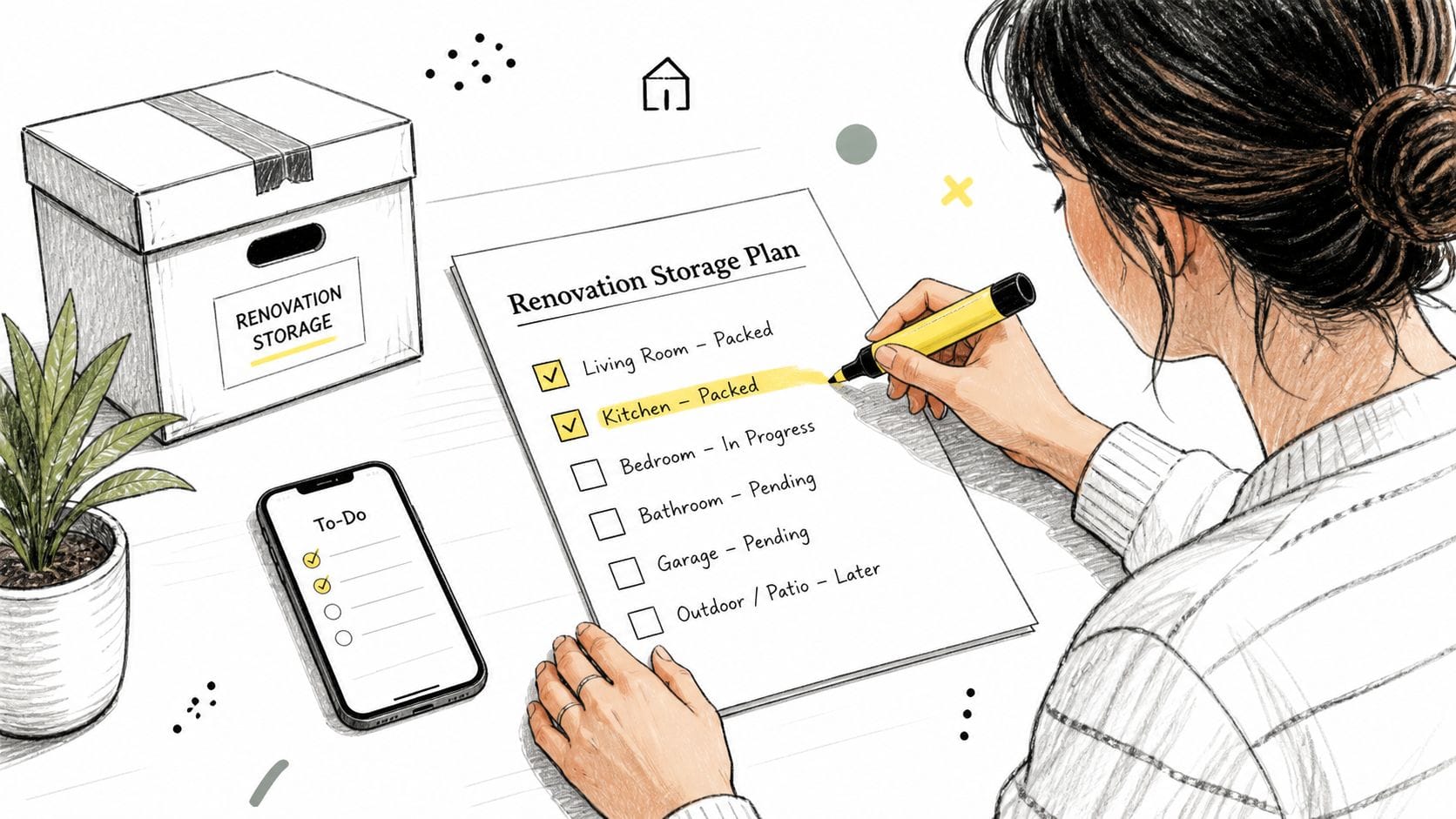
The most common failures are missed insurance declarations, vague inventories, unconfirmed parking and redelivery booked before the property can receive furniture. Written confirmation gives the homeowner, contractor and removals company the same operational plan.
We can survey a London flat or house, arrange delivery to and collection from storage, handle furniture dismantling and packing, and coordinate access around borough parking restrictions. Contact Best London Removals to discuss a renovation decant with a clear written quotation and a practical redelivery plan.